Later this year, the town of Birkenhead becomes an art gallery. The Town is the Gallery, a large-scale, multi-venue programme will encompass everything from pop-up galleries and public art installations to workshops and participatory projects. Ryan Gauge, co-founder of organisers Convenience Gallery, says, “Using the town as the canvas, we’re working to achieve the aim that anywhere can be a place for arts and culture.” Taking place over several months, the programme will peak in September. “We have had contact from over seventy artists so far and we’re really excited by all the proposals,” Ryan adds.
On the Brightside, Convenience Gallery in Cahoots. Photo: Convenience Gallery
The Town in the Gallery will be something of a culmination of creative growth which has been building in Birkenhead, my hometown, over the last few years. Not so long ago, like many similar post-industrial places, if Birkenhead was mentioned in the media at all, it was negatively. Yet, there are some who are now saying The Future is Birkenhead, as a set of cultural organisations, plans and projects are shaping into something other areas could learn from.
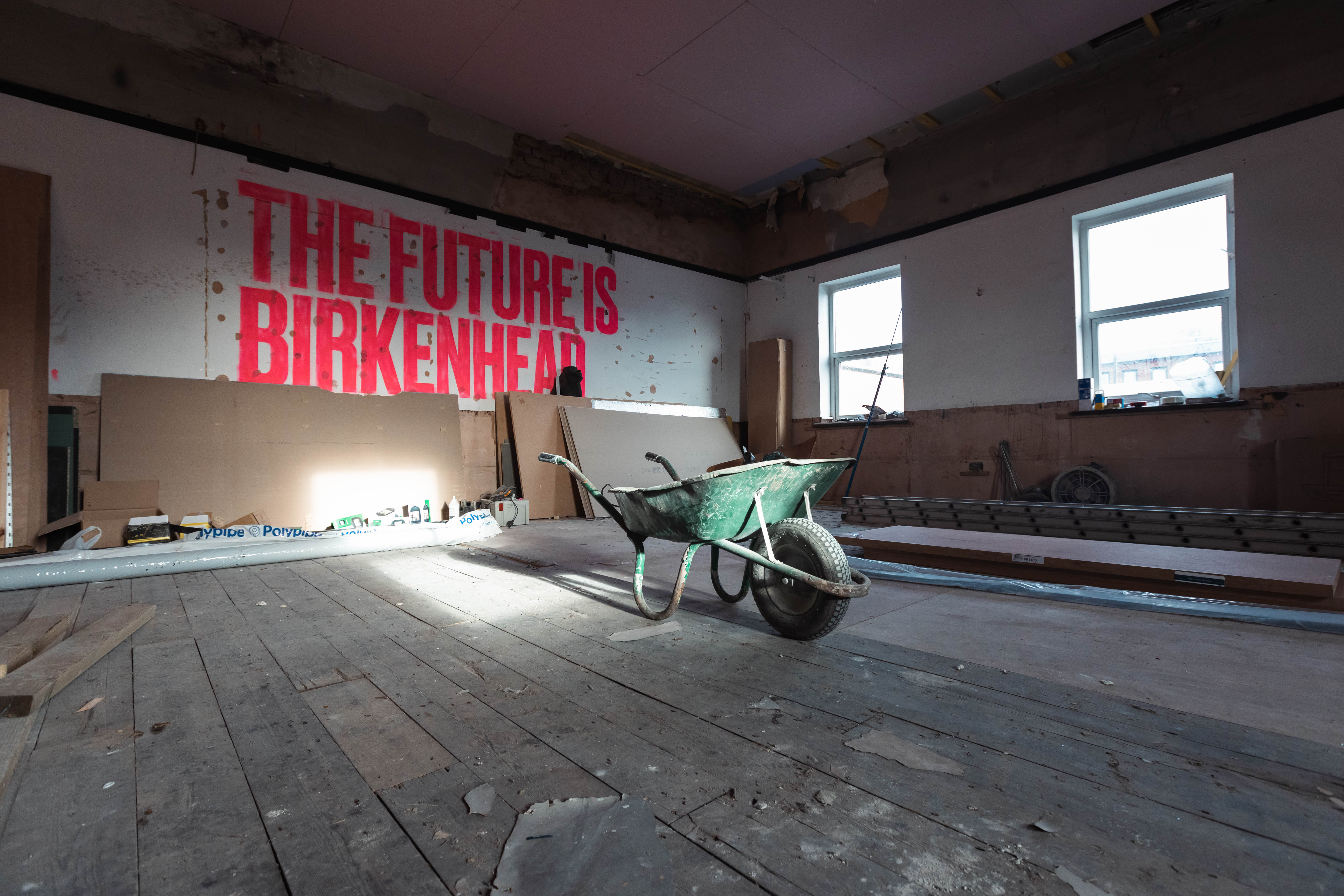
The outfit which has perhaps blazed the biggest trail in the town is venue Future Yard. Attracting national attention for everything from its community ownership model to its training programmes – and for coining that tongue in cheek slogan, The Future is Birkenhead.
Future Yard. Photo: Robin Clewley
Craig Pennington, Future Yard’s director, details what drove its foundation: “There’s a huge wealth of artists from this part of the world. There was little in the way of support for artists and very little in the way of access to the industry for local young people. The idea was: stop thinking about a venue as a nice-to-have cultural asset. Think about it as an absolutely key anchor institution that can bring about dynamic and meaningful change in a place.”
That Birkenhead is now listed on touring schedules alongside much larger cities is powerful, but Future Yard’s impact goes beyond that. “Now 80% of the employed staff in the venue have come through our Soundcheck training programme,” says Pennington.
Photo: Robin Clewley
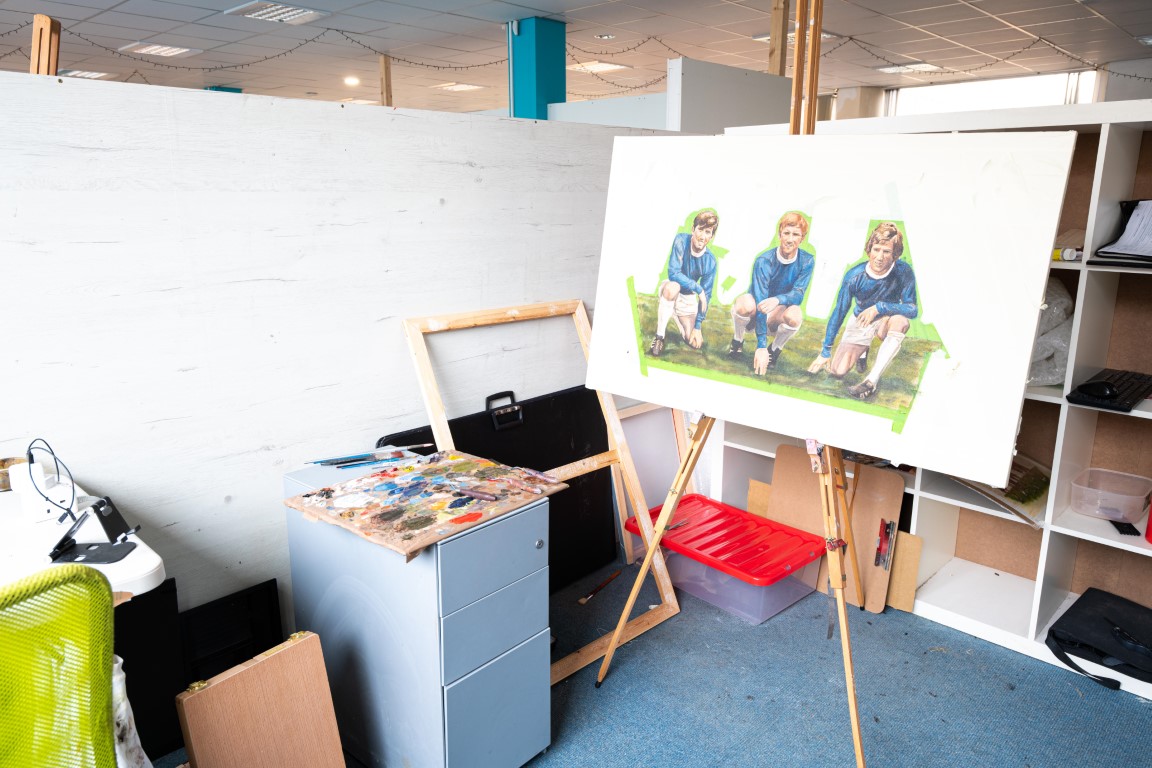
These however are just two examples of culture-focused developments making change in the town. If all goes to plan, within a few years Birkenhead will have at least two creative studio complexes with event and exhibition spaces; two sites dedicated to fostering wellbeing through creativity; a artists residency space in an former observatory; two new museums and a new park with spaces for cultural activities. For the most part, this is all happening in places that were previously empty or underused.
While these developments are happening in co-operation with the local authority, it’s significant that they are by and large being defined and led by grassroots organisations. This is in contrast other past examples of cultural regeneration in post-industrial places such as in Gateshead and Bilbao. Pennington says: “You have a small number of organisations with shared aspirations and ideas, but working in different ways and in different spaces. Clustering those geographically has had a profound impact.”
Another of those organisations is Open Door, which provides mental health support. Birkenhead, in common with many post-industrial areas, has poor health outcomes, so such a charity is vital. But how did they end up running the Bloom Building, which hosts everything from workshops and exhibitions to performances and events?
Bloom Building. Photo: Lydia Tweed
“Bloom is rewriting the rules around how the worlds of culture, community, social action and mental health can flourish together,” says Frankie Hughes from Bloom. “Reimagining not only common approaches to mental health, but also how culture can act as the catalyst for change and cultivate social value.”
Open Door are now planning an additional new facility called ‘Joy’ developed in partnership with a local NHS Trust. The aim is for it to be a national centre of excellence in how culture and wellbeing sit alongside clinical services. Development Director Ella Holland says: “Arts and culture will bring people to the centre; everything within it should all wrap around this central theme.”
In some ways, these developments should not be a surprise. Birkenhead had the world’s first municipal park and the first school of art outside London. It was also home to an important Arts and Crafts pottery and one of the few UK firms to produce fine tapestries. Creativity and urban innovation are rooted in its history, yet this has been obscured by the profound impact of its economic decline.
Make Hamilton Studios. Photo: Graham Smillie
The town’s history is the focus of another of Convenience Gallery’s projects. Ryan Gauge says: “The Uncovering Birkenhead’s Working Class Historyproject is about championing local memories, stories and histories. Birkenhead is at a pivotal point in its cultural development and we want to ensure the people’s history is a part its future.” In the longer term, Convenience Gallery are also looking to open their own space.
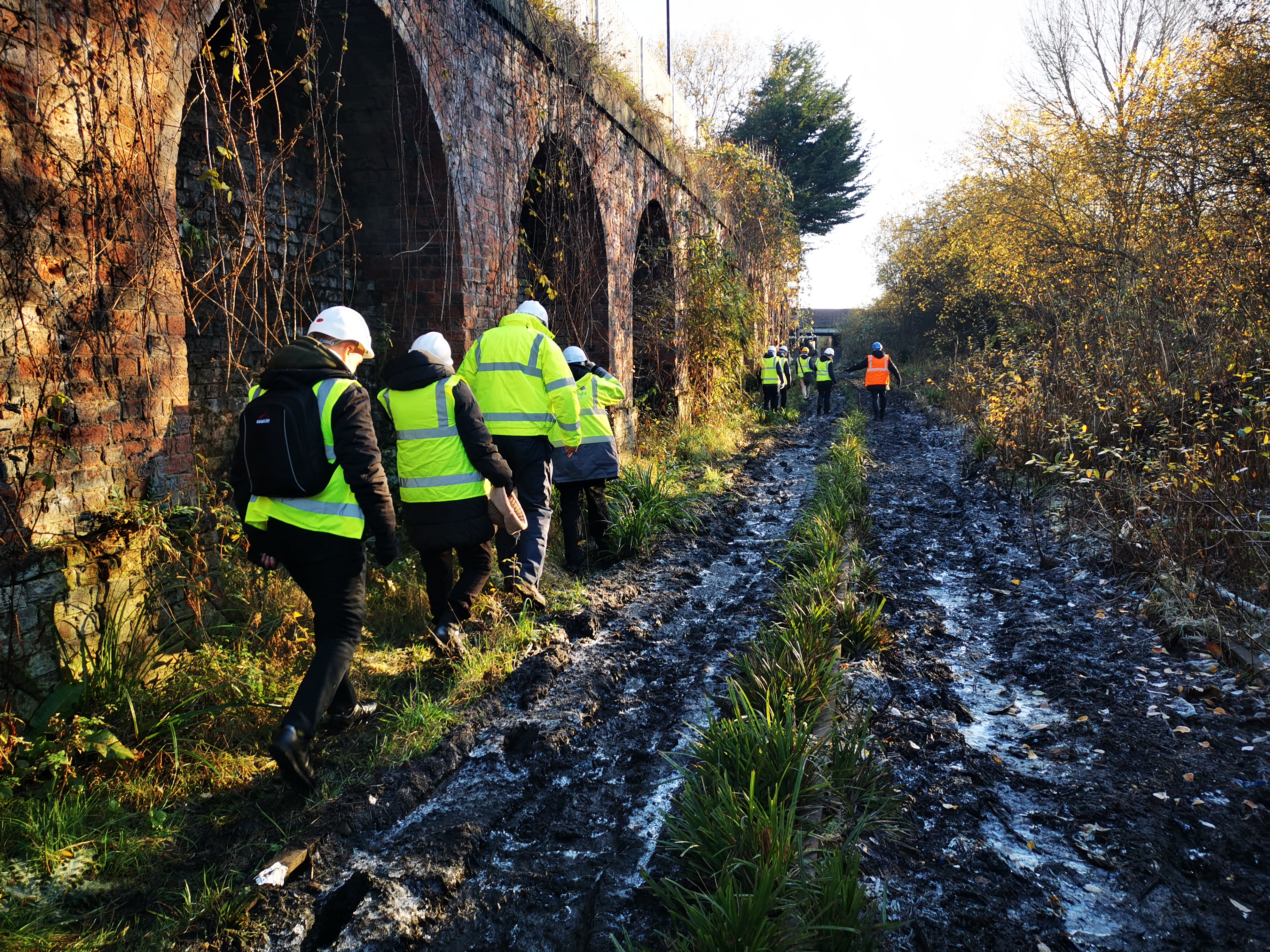
All this cultural development isn’t happening in isolation; it’s part of a wider masterplan the Council say is the town’s biggest transformation since rebuilding after the devastation of WWII. Crucially, it does not fall into the trap of thinking that cultural projects alonecan regenerate a post-industrial town, as has happened elsewhere in the past. Connecting some of these developments up will be the new Dock Branch Park. Created from a long-abandoned freight railway line, the park will include space for outdoor exhibitions, installations, performances and education. As well as a new museum, The Transport Shed. These projects are particularly personal for me, as my dad worked for many years in the attached railway workshops.
Dock Branch walking tour. Photo: PLACED
Architecture and design practice OPEN is working on plans for the area. Director Jaimie Ferguson says: “Dock Branch Park physically connects the key features in the town centre and provides unique new green spaces as part of a transformed public realm, but it also says a lot about how Birkenhead sees itself in the future.” He continues: “We’ve also been collaborating with artist Di Mainstone to develop ideas for a cultural programme around a bio-diverse revolution.”
Impression of Dock Branch Park. Image: Open
So far so good, but is some of Birkenhead’s cultural growth simply due to the extensive urban development that’s taken place in central Liverpool, so close by? Gentrification might be a concern. Yet as a phenomenon, gentrification tends to have its most negative impacts in cities (and their satellites) which have the largest concentrations of wealth and power. While it might one day become an issue for Birkenhead, it is currently a long way down a list of bigger challenges around employment, poverty, health, dereliction and access to opportunities and services. There of course is the crux that underpins many of the UK’s problems – intense over development in some places and deep-seated underinvestment in others.
I ask Craig Pennington what he thinks is needed to ensure everything achieved so far in terms of culture and community is built on: “Whenever you have a situation where profound change is happening in a place,” he says, “you have to be really, really mindful of the fact that local people are at the heart of shaping what that change is.”
Convenience Gallery co-founder Andy Shaw agrees: “Naturally with change comes some apprehension that it might be something not for local people, but Birkenhead feels like it’s doing it differently. It’s grassroots and community-led.”
Make Hamilton Studios. Photo: Make CIC
If what is currently happening on the left bank of the Mersey means one thing for other areas, it’s that cultural development in post-industrial places has to be driven by local needs and opportunities. By specificity and originality. Not only will this serve local citizens better, uniqueness is also what attracts wider attention.
Ryan Gauge says: “We would love to see more jobs created locally and especially within the creative industries, passing on opportunities for the next generation to have tangible creative careers and to really see these as accessible and viable options.”
Future Yard outdoor space. Photo: Robin Clewley
This is a key point. To make a regular living form creative work, you usually need to be part of a wider infrastructure. Can this cultural growth lead to increased employment in the creative sector locally? Perhaps even five years ago, this may have seemed a pipe dream. Yet there appears to be some increasing dispersal of cultural jobs away from the south-east. That area’s huge dominance adds to the inequalities of the sector. Channel 4’s move to Leeds and the BBC to Salford have attracted attention, but organisations fromHachette to Art UK and EMI have also been shifting operations northwards, while smaller cities like Sunderland and Wakefield are developing their creative sectors significantly. Could this be the next step for Birkenhead?
While writing this, I began reading The North Will Rise Again by Tyneside based Alex Niven and kept thinking of a quote he opens with, taken from the processional banners of Durham miners:
”The past we inherit. The future we build.”
Photo: Robin Clewley
This piece was published by The Quietus in May 2023.
In the 2000s there was a boom in new cultural facilities opening in the English regions, often in places whose economies had struggled since the 1980s. Many of them subsequently had significant challenges connecting with local audiences. Most of these new facilities were based around a particular model of art and cultural consumption that had its centre in London and other global megacities. Such organisations, when they opened, largely employed in their senior roles white middle- or upper-class people who were drawn from elsewhere and who often shared remarkably similar career backgrounds.
Nevertheless, some junior jobs were created in such places. I began my career in one of them in my native Merseyside on a zero-hours contract. Despite being passionate about art and culture, I soon became alarmed at how such organisations often seemed more focused on recognition from their peers than from the communities they were based in; as well as a wilful lack of acknowledgment that inequalities existed within and outside such institutions. Experiences such as these drew me to work in what was then called community arts, a field which seemed to at least try to address the relationship between key practices in culture and wider society.
Much of course has occurred since. Such community practices, once written off by the ‘mainstream’ cultural world, are now seen as part of the fore of contemporary culture. Class, for a time dismissed by many as irrelevant, has come back to bite.
There has also been a move away from that previous model of cultural development in the regions, with programmes such as Creative People and Places (Arts Council England) having shaken up things up a little. Yet much more needs to be done. Too many organisations still fail to employ people from working-class backgrounds and from the communities they’re based in, especially at management level. Even now, many organisations still struggle to seriously engage with many communities and cultures.
While class is our focus here, it is important not to privilege it over other inequalities. Nor by taking about organisations engaging with local cultures do I mean separating out the ‘white working class’ or a specific requirement to have been born somewhere. Class has had renewed attention recently, partially because it was almost written out of the conversation for 20-30 years. Notably it was removed from 2010 Equalities Act upon its introduction into legislation.1 Yet we must be careful not to fall into the rhetoric of divide and conquer when it comes to change in the cultural sector. I refuse to allow the exclusion of those from my socio-economic background as an excuse to further marginalise working-class people of colour who face even more barriers.2
The cultural sector more seriously engaging with class and regional identity is at its heart about social justice. It is also, though, about making cultural organisations more effective and sustainable. As is well established in business studies, having personnel from diverse backgrounds is a powerful driver in creating more successful organisations of all forms.3 Perhaps none more so than in the sector where culture is both the main input and output, and new ideas and perspectives are often vital to success.
Yet, as evidenced by an array of research and demonstrated in rigorous detail in the 2020 book Culture is Bad for You by Brook, O’Brien and Taylor the majority of the cultural workforce is still drawn from narrow sources and it remains one of the most elitist areas of work.4 This has real impacts on the culture that is produced by the sector, which in turn significantly impacts on how society views itself. Some of these inequalities are structural and beyond what the cultural sector can change in itself. However there remains much that the sector can do.
Currently the vast majority of culture workers have similar entry routes via university. While this works for many, to increase diversity in the sector we need to create more varied forms of entry. Requiring a degree is a class barrier in itself, especially as higher education has become more expensive. That divide is further widened for those who have to work alongside studying, to support themselves. There has been a positive movement away from unpaid internships in the sector, but some still remain and these are a major obstacle for those who can’t afford to work without pay.
Increasing school and college leaver entry into employment into cultural organisations is vital. There has been a growing array of initiatives for this, though the way apprenticeships were reformed in recent years has made it harder for some smaller cultural organisations to access them. However, too often things fall down in how staff are developed after they take up such entry-level roles. There need to be serious career development pathways put in place, especially in medium and large cultural organisations, where people can start as an apprentice and work their way up to senior management, especially in the ‘creative’ side of organisations where this is most often lacking. We need to develop sustainable routes to entry, including those with part-time study alongside on-the-job training, which is common in other fields, for those who cannot, or who don’t want to, take the full-time student route beforehand.
A new model needs to be cultivated where people can develop their career both within organisations and within a region. This is especially important outside of London, where even the largest cities only have a modest number of cultural organisations and jobs and so the tradition is for key management and leadership positions to be taken by highly mobile people from elsewhere. Currently, to not move about like this is to significantly reduce your career options. This is something I had to face when, having spent my whole life in Merseyside, it became apparent to me in my late 20s that unless I was prepared to work in other places, I would hit a career wall, so I spent several years moving around. While this had many positives, it also meant losing connections with family and friends as well as much financial strain. At a structural level of the cultural sector, this reduces opportunities for development for locally based candidates. It also undermines the depth of local engagement by institutions, as personnel move around and constantly have to acquaint themselves with new situations.
Those who grow up in a particular place, even if they have lived away for a time, tend to be more rooted in its stories, its cultures, its complexities and its contradictions. Thus their understanding of audiences can be much more enhanced. It’s also vital for younger participants and junior staff to be able to see someone who is from a similar background to them in the top positions when they are starting out — both in terms of class and regional identity. This is not to ignore that there are also benefits of having worked in a few different places, for staff and the organisations they work for, but to argue for the need for more plurality in how people are recruited and developed in the sector than now. Of course, being from somewhere in the regions and being working class are not one and the same, but class and place have particularly important crossovers in the regions, in terms of access to opportunity, mobility, experience and connections.
Recruitment processes also need to take better account of socio-economic diversity. For example, removing the qualifications requirements for jobs unless they are actually needed and taking account of the challenges to career development that people may have faced due their backgrounds and circumstances; with cultural institutions taking up opportunities to collaborate with specialist organisations who can help with diversifying recruitment. As well as for staff, the same goes for the recruitment of artists. This means enough open application opportunities, but also enough direct support for artists to apply who may have less confidence and experience, including ‘payment for pitching’ when appropriate.
The need to recruit artists from diverse backgrounds is even more acute in collaborative projects with communities. Too often artists from middle-class backgrounds are commissioned to engage with working class communities. While this meeting of different experiences and ideas can be powerful, just like with management of cultural organisations, it reinforces the idea that a certain type of person gets paid to make culture and lead projects. While of course having similar backgrounds does not always result in equivalent understanding or equal power relations, some shared experience between an artist and a community they’re working with does tend to make the navigation of such intricate relationships easier.
It’s important not to fall into the trap of thinking working class = better, as comfortable as it can feel given the unequal relations across the class sphere and the long tradition of dismissal of working-class cultures. This can be inadvertently patronising. Power, space and support is what working-class people need in the culture sector, not sympathy or awkward deference. I’m proud of my working-class background, its richness, vibrant culture and energy, but aspects of it, like all cultures, had its share of prejudice, narrowmindedness and exclusion. Employing and platforming working-class people and those from other structurally disadvantaged backgrounds helps create the conditions to tackle these issues and complexities in culture, because they have the direct knowledge and experience to do so. However, this then has to expand back out beyond specific projects to impact the wider operation of a cultural organisation, its relationship to its audiences and how it communicates its work.
One of the biggest issues stemming from the lack of diversity of those employed in the cultural sector is how this helps generate a kind of shared perception of ‘how things should be done’ and of what has value. Shifting organisations away from this is vital for change. That is not about completely abandoning professional practices built up over years, as these are often hugely effective in creating powerful culture. More, it’s about how cultural organisations, especially those distant from the biggest centres of cultural production, take on board what happens when their established knowledges and practices meet and intersect with different forms of knowledge and experience. I think of a quote from the Turner Prize-winning artist Mark Leckey, who grew up in the same area as me, upon his retrospective exhibition at Tate Britain in 2019: ‘This is the world I belong to now. But at one point I belonged to another intelligence.’5
The current model places institutional ideologies and practices, which may cross national borders but tend to be governed by particular classes throughout, way above other perspectives, and this is increasingly being challenged. When a space can be created where different types of experience and intelligence can respect and acknowledge each other and find crossover, that is a really interesting place from which many great cultural productions have resulted. This goes back to the traditions of things like Augusto Boal’s Theatre of the Oppressed6 but such thinking is now expanding into other forms of culture and I feel we’re just at the beginning of it.
Now more than ever, cultural organisations need to reconsider their traditional value and production systems, to be more responsive, more dynamic and distribute resources more evenly across all forms of programming; not just in terms of financial investment, but how things like time, space or personnel are allocated. If organisations are to be more engaged with the places they are based in and attract a wider range of people, a focus on a constant stream of big productions which need large audiences and significant media attention to justify them, is not always the best method. Projects at scale can be powerful, inspiring and popular, but often take up so much resource that other forms of programming can be held back. Allocating resources more evenly and working in a way so that the often artificial barriers between ‘types’ of cultural project are broken down would allow for a greater variety of more innovative and open-ended programming. This will also benefit less experienced employees in being able to lead their own projects at an earlier career stage and work with less experienced artists and practitioners, meaning organisations can invest more of their resources in new voices. Crucially, this will also aid those who enter the cultural sector from more diverse backgrounds in not being siloed into particular areas of work just focused on community engagement, so they are able to bring their ideas and experiences to influence across an organisation’s work.
Of course, any form of programming takes up resources and doing ‘lots more’ might not automatically result in more depth, more diversity or better relationships with communities, but rather in exhaustion and even audience fatigue. Yet as we need to look hard at how cultural provision is done, stepping back from the current model could mean that new and more diverse forms of programming can emerge in the space that is created. In doing this, some organisations will need to shift their focus from getting validation within their particular field to gaining recognition from the communities which surround them. Yet the two need not be mutually exclusive. Doing work more rooted in particular places can often create more original programming that in turn attracts more critical attention and wider interest, rather than merely replicating the sort of bourgeois contemporary culture that can be found all over.
Some argue that current cultural organisations need to be replaced entirely. The fact is, people have been calling for the traditional academies/museums/theatres etc. to be abolished for almost as long as they’ve existed and it never happens, rather they change and adapt under new influences. Even new and radical organisations, if they don’t burn out, have a tendency to solidify and become ‘institutions’ themselves soon enough.7 While funding should certainly go to new and different organisations and new cultural forms, this doesn’t negate the need to change existing ‘pillar’ organisations to make them more relevant to contemporary life, because they’re not going anywhere.
There are also arguments that too many resources have been put into buildings rather than programmes over the past couple of decades. Yet we should also not forget how many cultural facilities have also closed in recent years, in particular those in more underinvested towns and cities. Many people live a long way from good quality facilities where they can create or experience culture. Buildings are not bad in themselves, it’s about the right type of buildings being used in the right way to meet people’s wants and needs. If you find your building doesn’t fit your organisation’s mission, change the building, not the organisation.
In the regions the largest cultural funders were traditionally local authorities,8 however, many of them now struggle to do this. Thus as culture has become something increasingly set, defined and funded by people based in the largest cities, this has perhaps added to the alienation felt by some people from the cultural sector. Especially as cultural provision in smaller towns and cities and rural areas has in many cases become increasingly vulnerable if not closed completely. By changing how cultural funding is allocated and distributed so more power is put into the hands of the people in the regions themselves, they could better allocate resources to meet complex local structures and needs.
A not dissimilar feeling of alienation is often felt by working-class people when they enter the cultural sector and find organisations, even ones they are passionate about, have an awkward relationship with people from their background. If supported, they can be positive agents of change. Yet for now, as it says in Culture is Bad for You: ‘Those who have the most insight into the problems are often given the least power.’9
This is a process of both short and long-term change. As someone from a working class background who now has a relatively established position in the cultural sector, like many others I can bring a particular perspective that can hopefully contribute to this. Yet, getting a handful of working-class people into positions in the cultural establishment is not enough. There needs to be a pipeline created to ensure there is a constant renewal of people from diverse backgrounds, including socio-economic, entering the sector, and crucially, developing in and changing it.
Given the huge tectonic shifts presently shaking the very foundations of many cultural organisations, if more do not change faster, they will struggle. If the sector embraces some of the above though, it could become more sustainable and produce forms of culture that engage a wider diversity of people. It could also contribute more to our contemporary communities, encouraging greater understanding of our society, the issues it faces and changes we need to make.
O. Brook, D. O’Brien and M. Taylor (2020), Culture is Bad for You: Inequality in the Cultural and Creative Industries. Manchester: Manchester University Press, p.65
Cranfield, B. (2016), ‘It Should Not Be to Its Past that the ICA is Beholden, Rather the Needs of the Present and Future’ in Apollo, 31 October 2016, https://www.apollo-magazine.com/past-ica-present-future (Accessed 6 February 2021)





 Kenn Taylor