TISH: Class, creativity, and inequality in British art

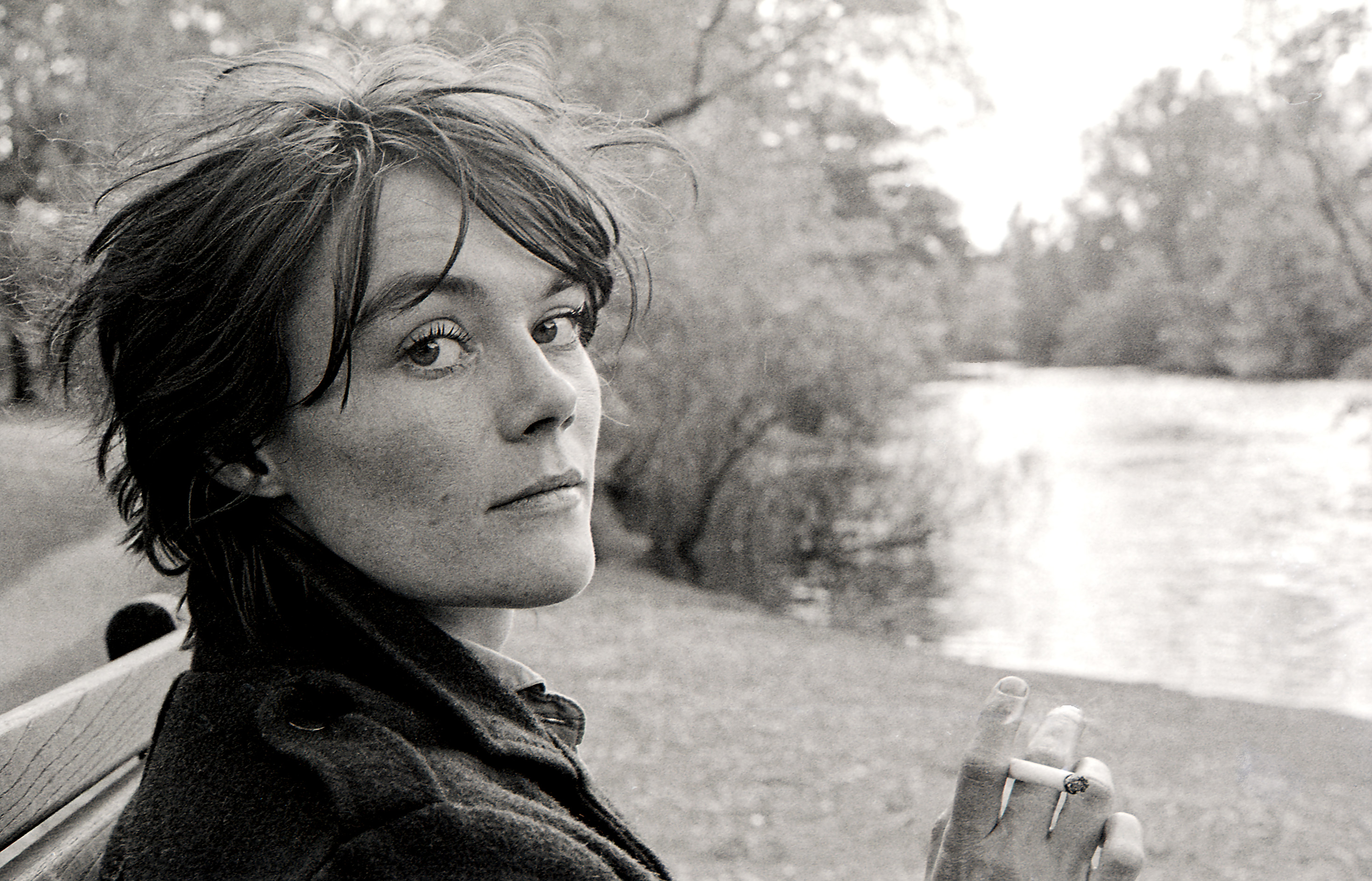
Tish Murtha Portrait by Tish Murtha © Ella Murtha

By Kenn Taylor

In 2021, when we were all still reeling from the ongoing effects of the pandemic, a Kickstarter on social media caught my eye: a project to make a documentary about the life of photographer Tish Murtha, by director Paul Sng and Tish’s daughter Ella.

I knew of Murtha’s work through my deep interest in the photography of working-class communities and places. Yet, until I read the synopsis of the film, I’d not been fully aware of the scope of Murtha’s work, or the extent to which she was let down as an artist and a person by society.

After finally being able to view TISH in late 2023, these impressions have only been deepened by Sng’s powerful work, which is both a subtle, rich portrait of Murtha and hard-hitting in its moral and political message. While Murtha’s photography speaks for itself, Sng brings her life and the background to her pictures vividly into focus.

No moving image recording of Murtha exists, so her story is told through a mix of interviews with people who knew her and footage of Tish being played by Maxine Peake, whose voiceover readings of Murtha’s writing reveal it was almost as compelling as her photography.

In TISH, Murtha’s biography is brought to life in all its complexity. Born in 1956, Murtha grew up as the third of ten children in a family on Tyneside. She spent her childhood playing amongst buildings earmarked for urban clearance in Elswick – an area of Newcastle that was the backdrop to some of her most well-known images. Tish was encouraged by acquaintances to pursue her interest in photography and studied at a local college, where tutors advised her to progress to the highly regarded documentary photography course at Newport.

She returned to the North East with a growing reputation for her work, later moving to London where her photographs were exhibited alongside the likes of Bill Brandt. But Murtha struggled to make a living, especially after becoming a mother, leading to a return to the North East. Her work wasn’t exhibited again in her lifetime and she spent her later years scraping by, applying for any sort of low-paid job going, before dying in 2013 aged just 56.

The film explores the driving purposes behind Murtha’s work, taken largely from within communities she herself inhabited. She captured and celebrated individual characters and communal experiences, even as she critiqued the situations her subjects found themselves in. Sng traces Murtha’s creative growth – and how that creativity was battered down by circumstances – as well as her anger at the scourge of mass unemployment and how it damaged lives and communities.

After moving to the capital, Murtha photographed people who made their living in London’s nightlife, some of whom she lived with. Her ability to immerse herself in this very different world and portray it just as vividly demonstrates her talent. Yet this nightlife project was to mark a high point in terms of her recognition within the cultural sphere, one she was unable to reach again during her lifetime.

Early in the film, photographer Mik Critchlow, who himself strikingly documented the Northumberland mining communities that he grew up in, says ‘You have to be in the tribe to photograph the tribe. You have to do the same dance.’ Critchlow’s statement encapsulates the power that underpins Murtha’s images. Her photographs of the children in Elswick do not romanticise or aestheticise its decaying urban landscape: their focus is on those kids as individuals, making the best of things despite what surrounds them.

Meanwhile, her images of Juvenile Jazz Bands might, in other, outsider hands, have resulted in a simplistic celebration of a ‘quirky’ North East cultural phenomenon of military-influenced marching bands. Murtha, though, took a critical eye to these bands, questioning what she felt wasn’t an adequate substitute for the real creative opportunities working-class young people lacked. This provoked the ire of some in the community. In response, she invited her critics to a public debate. To me, this clearly demonstrates the need to commission working-class artists to document their own communities. While some might think local creatives lack critical distance, it is in fact the insider’s eye that looks deepest, understands the wider context, and can confidently critique aspects of their own culture – even if it does not always win friends. Another piece of Murtha’s writing, read by Peake, details how she came to separate herself from Side Gallery in Newcastle and won an employment dispute with them. She dismisses a ‘clique’ at the gallery that saw ‘working-class poverty as beautiful’.

Peake later reads out an Arts Council England funding application written by Murtha, detailing her plan to document the diverse, working-class community of central Middlesbrough, where she ended up living towards the end of her life. The grant application was rejected. This is intercut with readings of some of Murtha’s job applications for work in kitchens and factories, adding to her CV, ‘I am also a keen photographer’. The dispiriting, dry jargon Murtha had to adopt for job applications contrasts strikingly with her passionate writing about photography and the subjects that she was covering.

Watching TISH in West Yorkshire, I could not help but think of Andrea Dunbar, the author of Rita, Sue and Bob Too (1982) whose early talent, difficult later life and death aged just 29 have been examined across films, books and plays, including Clio Barnard’s The Arbor (2010) and Adelle Stripe’s Black Teeth and a Brilliant Smile (2017).

As was also said of Dunbar, some of Murtha’s friends and relatives acknowledge that she could be ‘difficult’ and was someone who refused to compromise. One friend recalled how she got Murtha a teaching job in which she apparently lasted less than half a day. There, however, is the rub. We tend to admire artists who refuse to compromise in what they do – yet such tenacity is easier when you have people and things to fall back on. Dedicating yourself wholly to your creative work is so much harder when you have no external means of support – and even more so when you have caring responsibilities for others.

Working-class artists are frequently forced into situations where, if they cannot afford to invest all their time and energy in their creative work in order to get noticed by those in power, they risk being frozen out of already limited opportunities. The systems of cultural production and distribution and the critical ecosystem that influences them still take little account of how those from structurally disadvantaged backgrounds might come to creativity in later life, or might be forced to dip in and out of making art and balance it with other forms of work. Too often, talented people fall by the wayside because an inflexible system that constantly demands what is ‘new’ and ‘fresh’ to feed itself excludes those who cannot fit its narrow parameters.

There is also the matter of expectation. Artists from more privileged backgrounds often have the confidence, instilled from early childhood, that things will probably work out, that you can focus on your personal goals and that you’ll have the space and support to do so. Those from disadvantaged backgrounds frequently do not have this sense of security. Devastatingly, in the film Ella Murtha reveals that after her mother passed, she got a rebate cheque from her energy supplier. Tish was significantly in credit, but had still been afraid to put the heating on, not knowing where she might find the money in future. Conditioned, perhaps, to think that she didn’t even deserve this basic survival need. I can think of little more socially damning than this important artist – this human being – not only being denied support for her creative work for years, but dying afraid to put the heating on.

In many respects, things have got worse since Murtha’s death in 2013 for artists from working-class backgrounds trying to survive, let alone thrive, in their careers. Social security has become harder to access and harder to live on. Many regional and more accessible arts courses have been cut and fees have become prohibitive. Arts Council funding has been reduced, and many arts organisations, especially in the UK regions, are struggling badly.

Yet, there has been a growing, if overdue, interest in and critical respect for Murtha’s work. The film details that, since her death, Murtha’s photography has been collected and exhibited by Tate Britain. There has also been an increasing interest in the work of other photographers who captured working-class communities such as Mik Critchlow and Chris Killip – both of whom were interviewed for this film and are sadly no longer with us.

In part, I think this is due to the internet making these images more widely available and easier to appreciate by many more people who do not visit galleries or collect photography books. Especially as, in many cases, the work of Murtha and others documents places, people and things that are no longer with us. The passage of time, of course, also means creative work inevitably goes through a cycle of being contemporary, becoming ‘passé’ and then being appreciated once again.

But there is something else at play. Part of the reason the work of these photographers drifted out of mainstream recognition, having never been valued as fine art in their time, is that artists engaging with and exploring class and venerating working-class communities became deeply unfashionable for a time in the 1990s and 2000s. More recently, especially with the declining socio-economic situation in the UK, class –  which, of course, never really went away – is back with a vengeance as a topic in mainstream discourse. Inequalities can no longer be ignored or glossed over while the numbers in poverty grow and spread far beyond the areas most gravely affected in the 1980s – those places, like Tyneside, that were the ‘canary in the mine’. Thus, the world of culture is belatedly acknowledging the power and importance of these images, what they captured, and the artists who made them.

TISH is especially resonant now, while living standards are plummeting. Though this is, of course, a different context to the mass unemployment in the 1980s, Murtha’s story did make me wonder: what artists are trying to tell the contemporary story of working-class life now, but cannot get their work seen or heard because of their socio-economic situation? Or because of a creative sector which doesn’t do enough to accommodate and support them?

In England, it seems we do a good line letting talented working-class artists down, so that they can barely make work, or at least none that is seen or heard widely. Then, after they are dead and gone, finally appreciating them. It’s easier to do that, I guess. But how many artists don’t get ‘rediscovered’ like this? How much working-class creativity and history are lost? How many people don’t even get the opportunity to create in the first place?

TISH is a moving, arresting documentary. One that should cement the importance of Tish Murtha’s work, and of Paul Sng as a documentarian. An even greater tribute to Murtha, though, would be to appreciate and support working-class artists while they’re still alive.

This piece was published by New Critique in December 2023.
Representing Post-Industrial Communities in Culture

By Kenn Taylor

I grew up on Merseyside in the 1980s and 90s, when this region around Liverpool found itself on the extreme end of the UK’s wave of industrial decline in that period. This had a profound effect on my working-class family and community, and it shaped the way I think ever since.

Later, a period of new investment in culture and heritage in the area as a form of urban regeneration, coupled with increasing access to higher education, enabled me to work in creative fields not remotely accessible to my parents.

Yet this very access exposed me to the hollowness of some of these changes. Moving through different kinds of cultural work showed me how few working-class people worked in those sectors, except in the poorest paid service positions. It also made clear why their absence mattered. Rather than representing the experiences of working-class communities, many cultural productions treated them as ‘other’. Too often, they used and patronised the working class.

As I have written in the Journal of Class and Culture, most coverage of post-industrial communities comes from outsiders looking in. Their narratives often veer between relentlessly negative, stereotype-ridden stories and patronising ‘boosterist’ coverage, with all subtlety absent. On the rare occasions when people from such communities get to tell their own stories, they can be distorted by those who dominate and control the platforms where they appear.

My experience gave me an interest in the work of other practitioners who grew up in post-industrial communities had training which enabled them to work in creative fields, and then spent at least part of their energy drawing attention to where they came from. Many of these cultural workers have struggled to ensure their insider perspective is heard by a wider audience.

A good example is the 2021 short film Made in Doncaster by artist and writer Rachel Horne. The Guardian newspaper sent its ‘Anywhere but Westminster’ team to cover the Yorkshire city of Doncaster, and they invited Horne to be a subject of their film. Editor of a long running local zine, Doncopolitan, Horne responded with a challenge: if you want to make a film about the area, we’ll make it together. This attracted a great deal of positive attention nationally and highlighted Horne’s efforts to create a local media voice in the face of the decline of regional newspapers and radio. That decline has made journalism a more elitist trade and reduced opportunities for people living in disadvantaged regions to provide a counterpoint to skewed coverage from national outlets.

The film shows Horne’s determined efforts to feature the voices of people like her and provide visibility for the talent and creativity of the community, not just its problems. As Horne explains, solutions to those problems need to be led from within: “We’re resilient and we don’t need to be patronised. We don’t need experts coming in telling us how to fix things. We want to fix things on our own terms and that’s the way it’s going to work.”

In the film, Horne emphasizes the influence of the 1984-85 Miners’ Strike: “I was born in the miners’ strike. I lived through that whole collapse. It’s not just unemployment it’s like the whole culture went and then you’ve got ten years of austerity.” That influence is also clear in Sherwood, a 2022 BBC drama series created by writer James Graham who grew up in a mining village outside Nottingham, the setting for the series. This powerful drama explores a range of themes, including how all its characters are haunted, one way or another, by the miner’s strike and the subsequent disappearance of the coal industry in the area.

One of the tragedies of my lifetime is that the damage caused by the evacuation of industry without replacement, something once contained to certain areas, has, rather than being remedied in such places, instead gone on to consume much of UK. Sherwood highlights what many in the British establishment have been trying to gloss over and forget since the 1980s. As one of its principal characters puts it, “They didn’t care about us then, the don’t care about us now, they just use us. Look at what they still call us, what we call ourselves. A former mining town. Why? Post-industrial. How the hell are we meant to move on from that when even the way we talk about ourselves is by what we aren’t anymore? How are my grandkids meant to imagine a future beyond that, eh?” The spectre of deindustrialisation haunts Britain.

No other developed country has de-industrialised to the extent that Britain has. And artists like Horne and Graham, who grew up in deindustrialised places, can help us understand what happened and what life is like in these communities now, far better than the misrepresentations projected on to them by others. 

Graham, Horne, and I were able to attend university, where we honed our abilities to probe into and communicate about such things, drawing on direct experiences. The expansion in higher education from the 1960s to the 2000s gave us increased access to power to ask difficult questions and express the complex truths of our experiences and our communities. But such access, especially in the arts and humanities, is now contracting in the UK. In particular at the universities with the highest proportion of working-class students. Like us, young people from such communities today not only have limited local employment options, but they also have fewer educational opportunities.

Both Made in Doncaster and Sherwood contain hope for the potential of working-class cultures and communities in post-industrial areas. That hope comes from the resilience of people in such communities despite everything thrown at them.  It’s a hope though mixed with an ambiguity and a degree of cynicism that comes from having seen so little change for the better at a fundamental level over several decades. If we want anything to improve in future, voices like these must be heard more widely.

This piece was published by Working Class Perspectives in May 2023. It is taken from a paper I presented at the Transnationalizing Deindustrialization Studies: Deindustrialization and the Politics of Our Time (DePOT) 2022 Conference, Bochum, Germany, August 17-20, 2022.

A working-class artist is something to be

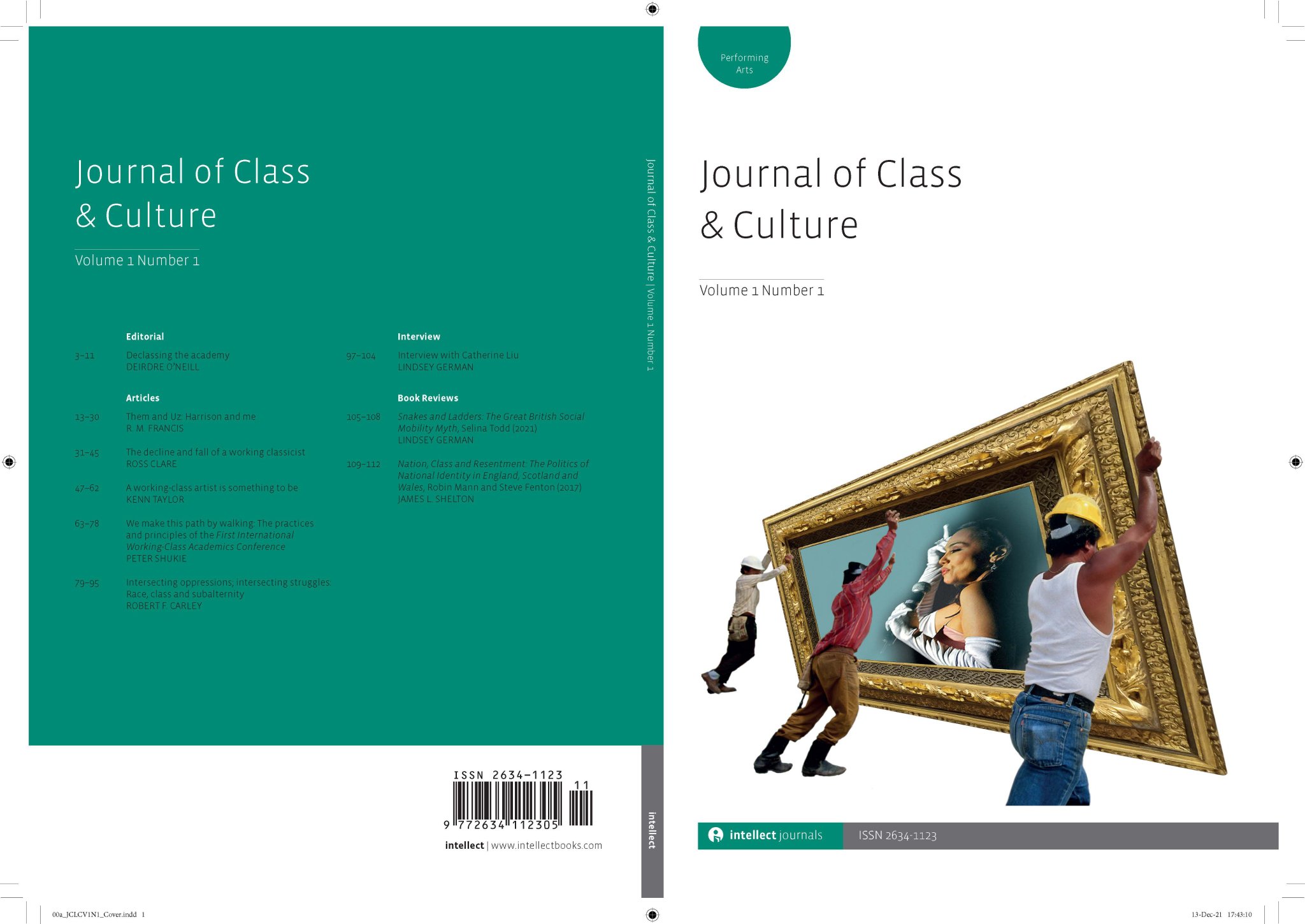
Cover of Journal of Class and Culture, Volume 1, Number 1.

By Kenn Taylor

Abstract:
The creative and cultural sectors in the United Kingdom largely exclude the working classes. Even the small number of working-class people who do ‘make it’ into these sectors often find themselves and their work badly treated by those who hold the real power. This article explores some of the experiences of working-class artists navigating the cultural sector and how exclusion, prejudice and precarity impacted and continue to impact them. It takes as its focus the filmmaker Alan Clarke and the playwright Andrea Dunbar, who were at the height of their success in the 1980s. It also considers the writers Darren McGarvey and Nathalie Olah, whose work has achieved prominence in recent years. It is through this focus I hope to demonstrate the long continuum of challenges for working-class creatives. This article also considers how, on the occasions when they are allowed the space they deserve, working-class artists have created powerful shifts in cultural production. Finally, it details some of the changes needed for working-class people to be able to take their rightful place in contributing to cultural life and the societal risks involved if they are denied that place.

The full essay can be downloaded from here.

This essay was published in Volume 1, Number 1 of the Journal of Class and Culture in December 2021.

A Spotlight On…Claire Walmsley Griffiths

Claire Walmsley Griffiths is a photographer from Blackpool, Lancashire who explores the possibilities of human connection through photography. She uses a camera as a tool for conversation, engaging with the psychology of people, place, identity, what community is, was and what it might become. Claire talked to Kenn Taylor about her work, her experiences as an artist and the cultures that she wants to explore and platform. 

South Pier, Claire Walmsley Griffiths, 2020

Kenn Taylor: How did you become a photographer?

Claire Walmsley Griffiths: I went to study fine art in Northampton in 1998. I started to photograph things to draw or paint from. Then I found people like Sophie Calle and Nan Goldin. What photography did for me, I just found it very accessible and much more of an accessible language in general for the audience. I became interested in how audiences could become involved in artwork or become part of that experience. And I think I’m still really interested in that.

It felt very different being at university in the south to what it was like in the north. A lot of pretence. I remember on one occasion one of my peers at art school calling me a ‘pleb’. It felt really obvious that I was from the north even though I’d never really considered it before. But also feeling very protective to the north and to Blackpool. I’m an overly-protective person of the place I live, but it has so many qualities that do not get celebrated.

Blackpool is often used as the poster child for ‘broken Brexit Britain’ by journalists and photographers. What do you feel about that, photographers coming in looking for a particular narrative they’ve decided on even before they arrive?

It is easy to feel that jolt when the media reflects images back at Blackpool, to say ‘this is your life’. Images that might suggest lack of hope or no alternative. As someone who lives here, it can be very difficult and there is a feeling of, where is the bigger picture?

It’s what we have been fed in Blackpool over a long period of time. I don’t think it’s helpful. Not that I’m like everything should be brilliant or Disney. But I think you have a lot of power with a camera and where you point it and that needs careful consideration. It’s really tempting for people to photograph the dark side of Blackpool. It’s too easy. Street photography has changed a lot in recent times. I think it was Susan Sontag who referred to taking a picture as an ‘aggressive act’. Perhaps social media has allowed people to question it more and also be more mindful of the camera’s power. But the stories that often get told of Blackpool are often not by the people of Blackpool. I think you have a right to document or photograph your own story.

Do you feel Blackpool gets ‘used’ or ‘othered’ by the media? This happened a lot to Merseyside in the 1980s and 90s when I was growing up there. Do you think the media commissioning more locally-based artists would create more balance?

I am interested in the psychology of a place, how residents, creatives and local artists feel in response to this consistent narrative. Othering is an easy route I guess especially using a medium such as photography because how much of creating a photograph can be non-reciprocal for the subject, it’s dangerous ground. I think there is a different narrative though in places like Blackpool that often does not get explored, through social and community approaches. Everyone has a right to be creative, it’s part of the human condition. People need to feel part of something, in a conversation or their voice valued. 

What did it feel like capturing those Covid lockdown images that became part of the #WorkTownGhostTown project [commissioned by The Grundy, Blackpool]?

Initially I did really enjoy the sense of peace, and there was a feeling of it being very ethereal. You could really see the buildings of Blackpool, when you look above and see the old architecture. I’d never really been able to do that as much previously I think because of vehicles going past. But then I really began to think about the performance industry and the music industry in Blackpool and the buildings that they take place in. Thinking about being younger and not being able to go and have that experience of meeting friends or drinking in pubs, or being able to dance and have a shared experience. I just really began to feel for those people and I started to speak to some of them and photograph them.

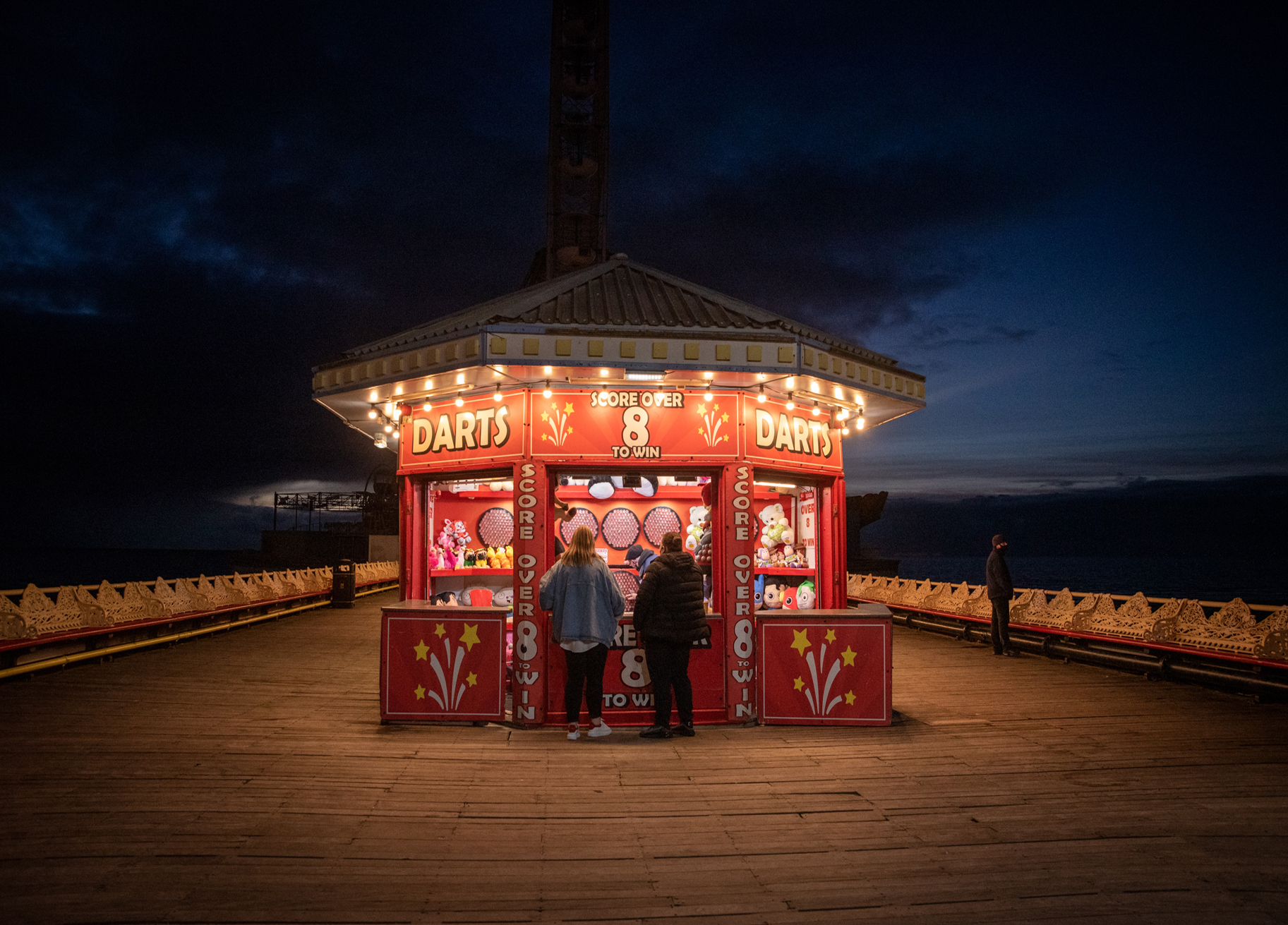
I went out again on the last day before the second lockdown, and I went on to Central Pier. It was completely quiet and I started to talk to the man who had the darts stand. If you’re someone who has grown up in Blackpool you probably will have done a job like that. He let me take his portrait and I wanted to make sure he was happy with it. He was just someone who worked for the stall owner, but he really seemed to love it. And that’s a really interesting aspect of taking photographs of people, just having time to listen to their story if they’ll share it with you.

The space of the Pier without people felt very unique, but it is really important that we do have people coming through Blackpool and spending money to support these small businesses, these music venues, grassroots venues that attract unique acts.

Central Pier Dart Stall, 30 Days Of Lockdown, Claire Walmsley Griffiths, 2020

You did a series, Seasonal Workers; is it important for you to show the story behind the seaside artifice?

I do think it’s really important. The seasonal workers stuff is ongoing. I photographed some horse and carriage owners having their, sort of, MOT last year. Their stories seem so important for Blackpool, the seasonal jobs make up part of Blackpool’s heritage. The horse owners I’ve met, they absolutely love their horses and seem to do it more through a connection to their animals than for the job. The generations of people who own the horses and donkeys, they go back for years and years. I think the carriage owners have had a very hard time with their season cut short.

Is it important to you to tell these stories, I’m also thinking of your Retired Performers series?

I think I’m just more and more interested in the shared experience and how people can connect and photography feels really accessible for that. The reason Retired Performers came about is I was photographing a circus festival. I met this lady and there was a photograph of her as a young person and she said ‘I used to be a foot juggler’. I said ‘what’s a foot juggler?!’ And she said ‘I used to spin people on a plank on my legs’. Then she said ‘oh yes my husband performed for Hitler’. Only in Blackpool! So she was the person who sparked the idea.

It was completely different to what I anticipated the project to be. I learned a lot through doing it. I wanted 30 people who had worked professionally in Blackpool. It’s like an underground scene really, all the retired performers know each other or have connections with each other, so they were introducing one another to me. They loved the experience of being able to talk about what they’d done. I wanted it to be a collaboration. I wanted them to feel happy with their photographs and that they were aware of what was happening with the work as much as possible. I wanted to create or encourage an exchange between sitter and audience. An invitation to be part of that backstage life, what goes on behind the curtain of and how we can feel part of that. The series of images allowed me to invite performers back into spaces such as The Tower Ballroom or Winter Gardens theatres where we kind of co-created an experience.

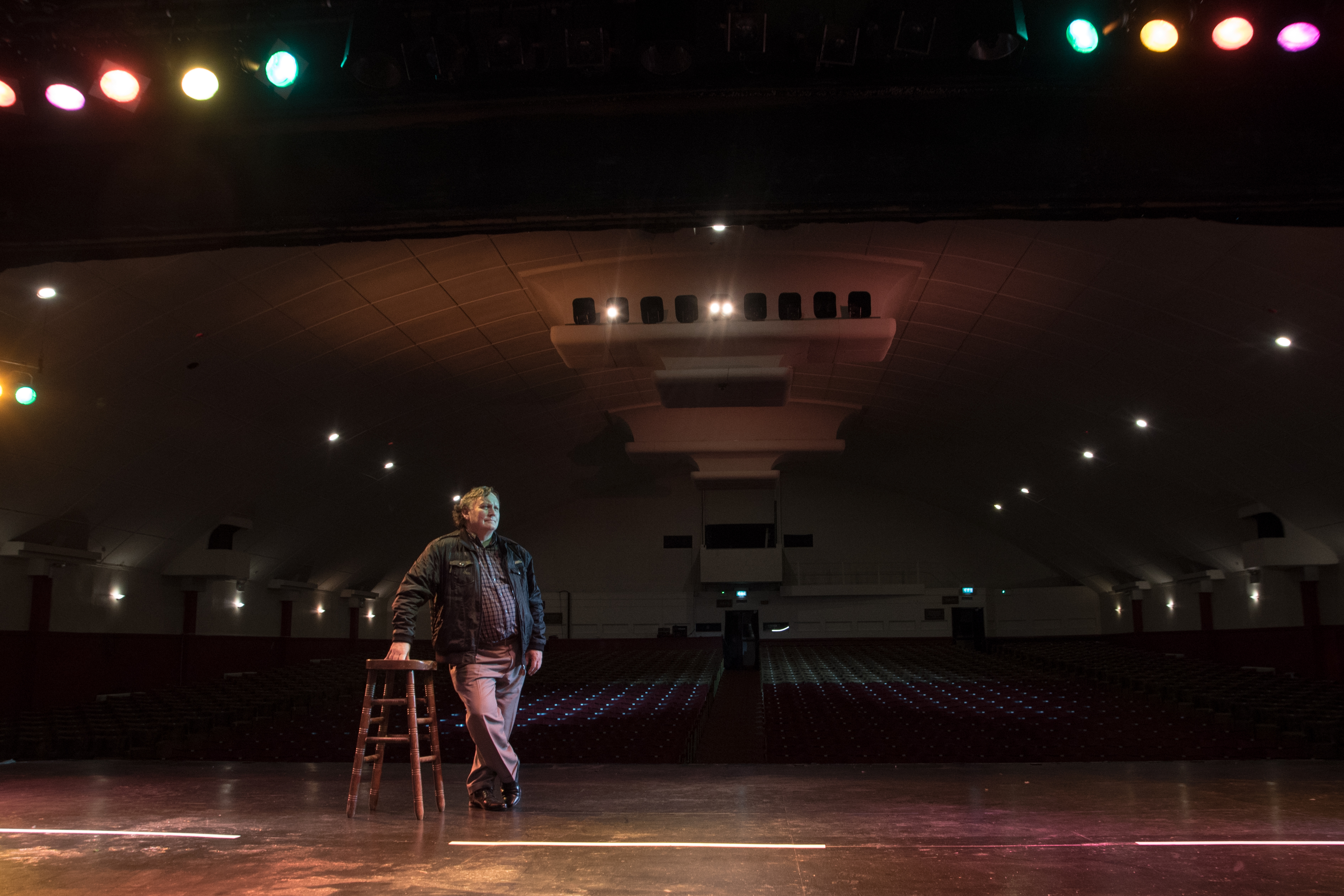
Stage Manager at North Pier Theatre Blackpool Denis, Claire Walmsley Griffiths, 2018

Is that one of the things you enjoy about social practice, connecting with people?

Within photography, I do like social documentary. I’m interested in that. But people like Mary Ellen Mark who was photographing her own life and stuff going on around her, just feels more genuine. I think it takes years and months to build those relationships. That, or it’s already going on around you or it has a strong connection to you. I am interested in people, I guess this is all about having that collaboration and finding a way to build relationships. That level of trust, that you’re already part of that community or have a connection to it. I think that’s really important.

What do you think of socially engaged practice as a term?

It’s a tricky term. I prefer socially based to socially engaged in some ways. I feel like it’s an inherent thing in people to want to be involved in the community. I think it’s within care workers, nursing professions, teachers. Socially engaged practice is something I came across by chance really. I guess it has been discussed as community art in the past. But the idea that you might be able to collaborate with a group of people to make work or give people a camera to tell their own story is really powerful.

Do you separate your socially engaged work from your other photography?

I don’t think I separate it from stuff I do generally. If I was photographing for tourism, if they let me arrive early and talk to people, that’s really helpful. If I’m photographing some civic event or street performance it feels uncomfortable if I haven’t said hello to people or found out a little bit about them. And the photograph seems better if I’ve had that experience already or if they know who I am.

Do you feel you were doing ‘socially engaged practice’ before you knew of it as a term?
I definitely do feel that. It’s because I’m in that community and I am that person from a one parent family, who’s had someone close to me with addiction, who’s had a friend that was homeless at a young age. I am that person and so are they, but we are also people with a bigger story. I keep thinking about how it is easy to demonise people who are living through difficult circumstances. That those voices do not have a chance to be heard and the stories that get communicated through other mediums are often regurgitated in the same old ways. I am interested in projects where the voice is a collaboration or the story or image highlights hope and space for exchange.

Tell me about your Retired Ravers project?

Retired Ravers is in process currently. I’ve been documenting an ex-cinema space that was later a nightclub and that has now been taken over by a theatre, come art space currently being regenerated by that very community. So it’s an amazing space, the perfect space to invite in people who were in that scene.

I’ve been thinking about that loss of community and shared experience and coming together isn’t happening at the moment. But I have spoken to someone who had been there in the late 80s rave scene in Lancashire and they were quite keen on the darker drug taking aspects being addressed, leading onto darker times for some people, so I’m just considering that at the moment. I see a lot of demonisation of addiction which is really damaging for people in recovery. Perhaps it’s a class problem, you have to pay for good recovery programmes. It just opened a new layer to what I had been thinking about photographing that counter culture.

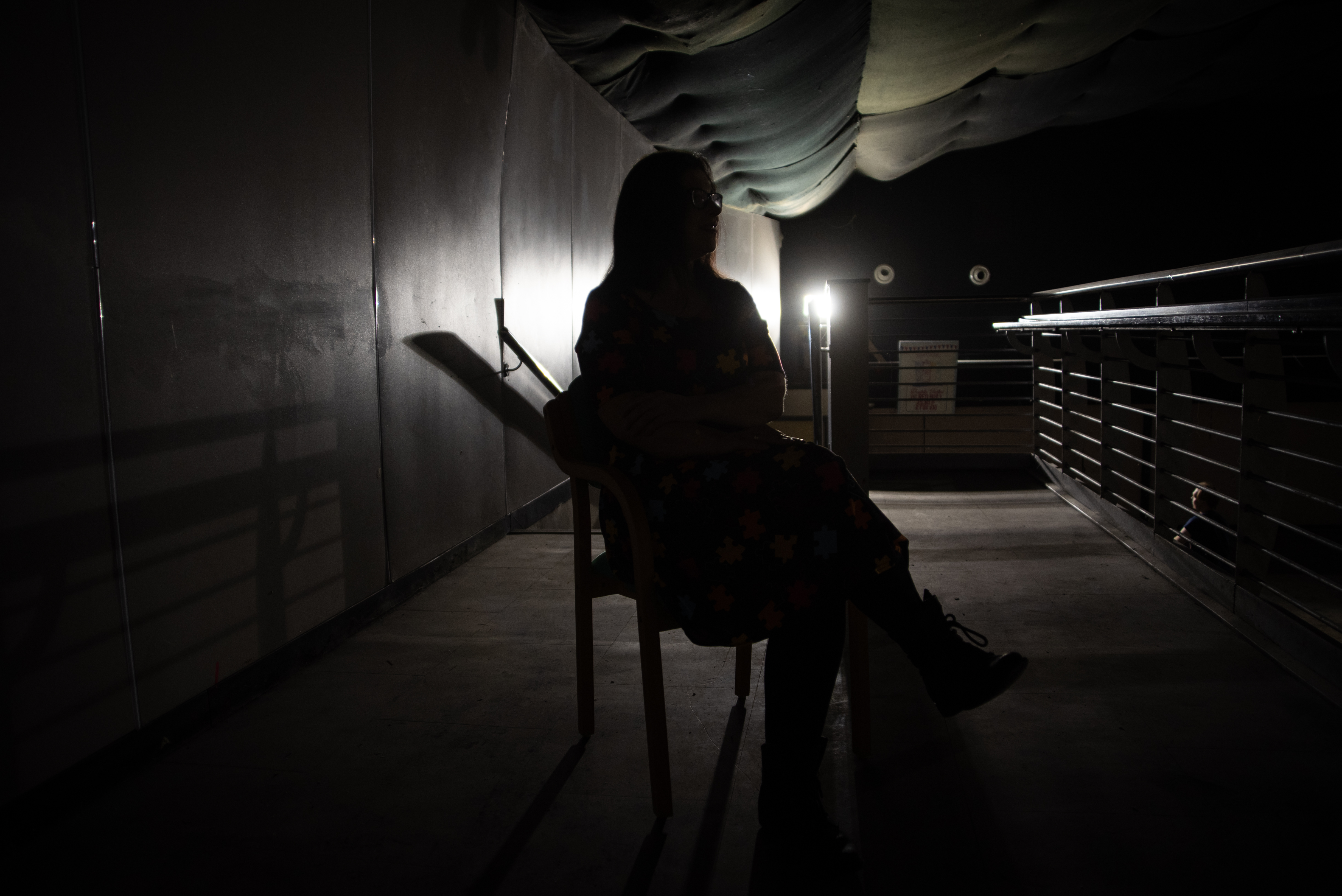
I’ve also come across quite a few women who were involved in the scene who would want to remain anonymous if they were to become involved in the project. I’ve done some test shots where I’ve photographed people anonymously, so just a soft light silhouette around people. Again I’m thinking of it as a collaboration with the sitter and the idea you could take a journey with people being involved in the project. One of the questions I want to ask those people is, was it a very accepting scene, but things feel very polarised now. Did they feel that youth culture would stay with people forever? The idea of freedom and liberty within that scene that perhaps some people felt. At its best that’s what it promoted. It feels like the places folks congregate or have a shared experience creates a kind of tangible energy.

Anonymous volunteer portrait at The Old Electric, Claire Walmsley Griffiths, 2020

Through your work in Blackpool as a photographer, what do you think you have discovered about community, and its future?

I am interested in how we come to believe limitations and our place in the world. That as human beings we look to identify with groups, that is my take on community – how we feel when sharing a story or relate to one another is powerful. It feels like people need to feel like they are part of something and how do we find that?

How important is class, and in particular working-class cultures, to you in your work?

I do feel like, what’s wrong with being working class? It used to be a celebrated thing and people shouldn’t be ashamed of it. I would like to see more celebration of all those working-class codes, the Working Men’s Clubs, Bingo, Rose Queens, everything. At Uni in the south, especially studying fine art, the last thing my peer group were interested in were working class stories and values, but it still gets fed back to us by media created by some who perhaps have not had that lived experience. I feel like there is opportunity now to see, hear and experience art and photography created by communities and working-class artists who are able to tell their own stories or collaborate in an empowering way. It feels like we are heading into a time where there is nothing to lose as long as we all keep listening, viewing and communicating whilst checking our own routes to what we believe is our destination.

This piece was published as part of the A Spotlight on Social Practice series by Open Eye Gallery in January 2021.

Socio-economic diversity in the arts: reflections on the Toolkit for Employers

The publication of Socio-Economic Diversity and Inclusion in the Arts is both timely and important.

I’m the son of a railway worker and a hospital cleaner and was the first in my family to go to university. When entering the cultural sector in a junior position, it was soon clear to me that it was, by and large, not really diverse
nor reflective enough of the communities it was funded to serve. Trying to raise the issue of socio-economic diversity (SED) in the sector in the mid-2000s was largely seen as unfashionable, irrelevant, something from the 1980s. An attitude that helped to hide some the inequalities that era glossed over.
 
Encountering classist cultures in the arts

Upon graduating, I got an interview for a diversity scheme for a major media organisation. I had been brought up in a culture in which presenting yourself well at interviews was seen as the main thing. So I bought my first ever suit for it on a credit card. I expected to talk about my portfolio of work, but was a little surprised to be asked to justify why I had been disadvantaged and why I deserved this opportunity. Being from a background were hiding poverty was key and that, ‘there’s always someone else worse off’, I was a bit stumped by this. In addition, in spite of being to a scheme to encourage the disadvantaged, it was led like a typical tough interview. These days I’d be able to answer all their questions quite eloquently, but then, I struggled, lacking the cultural capital that encourages public speaking and aggressive self-promotion from a young age.
 It was hard enough then to enter and survive in the cultural sector and it’s gotten worse in the last few years, especially in the more deprived regional parts of the UK where museums, libraries, youth facilities, further education colleges and theatres have all seen huge cut backs and closures.
 
The importance of measuring and monitoring socio-economic background  

The conversation on SED has, however, thankfully now started to shift and be taken seriously by the sector. When talking about measuring socio-economic background, quite often I’d be told ‘But how!’ as if it was impossible, rather than complex. The Bridge Group and Jerwood Arts’ Toolkit can help organisations to move into robust and applicable ideas, systems and actions. What’s great is it encourages a strategic rather than an ad hoc approach and uses methodologies with decent evidence behind them. Crucially, it advises how to practically gather this information properly and use it to make a difference in organisations.
 
The report highlights why this information really needs to be gathered: it exposes damming facts such as those from lower socio-economic backgrounds earn on average less than colleagues from more affluent backgrounds doing the same job.  

Top tips from the Toolkit 

Amongst the things that stood out for me in the Toolkit include being supportive, warm even to candidates in job interviews, so they can perform at their best. Rather than, sadly as I have personally experienced, some interviewers being cold or combative like it was some strange game. Another solid piece of advice is asking applicants to self-describe any barriers they may have faced in gaining access to the arts in an application statement. This is something that gives a candidate time to consider this in advance, as with the usual questions on a job description, rather than it being dropped on them at interview.  Its focus too is on recruiters considering skills and competencies over qualifications or direct experience is important, as is its advice on use of terminology. It’s also great that the Toolkit is split into baseline and advanced practice for organisations at different stages and scales.
 
The Toolkit also identifies where progress is happening in organisations. At Artlink, for example, we have already removed qualification requirements from job adverts, unless specifically needed, asking only for relevant information and stating clearly that we’re open to non-standard application formats. However, like any organisation, we can’t be complacent, even if we have made positive changes. Other areas we still need to think more about include avoiding, or at least explaining, cultural world jargon in job adverts, as well as ensuring adverts go to places beyond the usual outlets.
 
Next steps to make progress in diversifying the arts sector 

Practically, challenges remain with regards to gathering data. For instance, the socio-economic background survey for employees is long in order to ask the detailed questions needed for enough data for serious measurement. This could be off-putting for those filling in forms, especially if it is combined with gathering others forms of equality and diversity data. More work needs to be done as well to support the micro organisations that form much of the backbone of the cultural sector in how to get to grips with this area.
 
Change in the sector needs to happen though, with urgency, and positive action is crucial. Increasing socio-economic diversity in the cultural sector is harder in a society were inequality is increasing and some things are beyond what the sector in itself can achieve. For example, more work could be done around developing state-supported, multi-year creative apprenticeships.

Crucially this Toolkit also identifies correctly that this isn’t just a moral issue, a more diverse workforce, as a lot of evidence shows, creates healthier and more dynamic organisations that produce better art, which is something all cultural organisations should be aiming for.

This piece was published by The Bridge Group in November 2019.