Representing Post-Industrial Communities in Culture

By Kenn Taylor

I grew up on Merseyside in the 1980s and 90s, when this region around Liverpool found itself on the extreme end of the UK’s wave of industrial decline in that period. This had a profound effect on my working-class family and community, and it shaped the way I think ever since.

Later, a period of new investment in culture and heritage in the area as a form of urban regeneration, coupled with increasing access to higher education, enabled me to work in creative fields not remotely accessible to my parents.

Yet this very access exposed me to the hollowness of some of these changes. Moving through different kinds of cultural work showed me how few working-class people worked in those sectors, except in the poorest paid service positions. It also made clear why their absence mattered. Rather than representing the experiences of working-class communities, many cultural productions treated them as ‘other’. Too often, they used and patronised the working class.

As I have written in the Journal of Class and Culture, most coverage of post-industrial communities comes from outsiders looking in. Their narratives often veer between relentlessly negative, stereotype-ridden stories and patronising ‘boosterist’ coverage, with all subtlety absent. On the rare occasions when people from such communities get to tell their own stories, they can be distorted by those who dominate and control the platforms where they appear.

My experience gave me an interest in the work of other practitioners who grew up in post-industrial communities had training which enabled them to work in creative fields, and then spent at least part of their energy drawing attention to where they came from. Many of these cultural workers have struggled to ensure their insider perspective is heard by a wider audience.

A good example is the 2021 short film Made in Doncaster by artist and writer Rachel Horne. The Guardian newspaper sent its ‘Anywhere but Westminster’ team to cover the Yorkshire city of Doncaster, and they invited Horne to be a subject of their film. Editor of a long running local zine, Doncopolitan, Horne responded with a challenge: if you want to make a film about the area, we’ll make it together. This attracted a great deal of positive attention nationally and highlighted Horne’s efforts to create a local media voice in the face of the decline of regional newspapers and radio. That decline has made journalism a more elitist trade and reduced opportunities for people living in disadvantaged regions to provide a counterpoint to skewed coverage from national outlets.

The film shows Horne’s determined efforts to feature the voices of people like her and provide visibility for the talent and creativity of the community, not just its problems. As Horne explains, solutions to those problems need to be led from within: “We’re resilient and we don’t need to be patronised. We don’t need experts coming in telling us how to fix things. We want to fix things on our own terms and that’s the way it’s going to work.”

In the film, Horne emphasizes the influence of the 1984-85 Miners’ Strike: “I was born in the miners’ strike. I lived through that whole collapse. It’s not just unemployment it’s like the whole culture went and then you’ve got ten years of austerity.” That influence is also clear in Sherwood, a 2022 BBC drama series created by writer James Graham who grew up in a mining village outside Nottingham, the setting for the series. This powerful drama explores a range of themes, including how all its characters are haunted, one way or another, by the miner’s strike and the subsequent disappearance of the coal industry in the area.

One of the tragedies of my lifetime is that the damage caused by the evacuation of industry without replacement, something once contained to certain areas, has, rather than being remedied in such places, instead gone on to consume much of UK. Sherwood highlights what many in the British establishment have been trying to gloss over and forget since the 1980s. As one of its principal characters puts it, “They didn’t care about us then, the don’t care about us now, they just use us. Look at what they still call us, what we call ourselves. A former mining town. Why? Post-industrial. How the hell are we meant to move on from that when even the way we talk about ourselves is by what we aren’t anymore? How are my grandkids meant to imagine a future beyond that, eh?” The spectre of deindustrialisation haunts Britain.

No other developed country has de-industrialised to the extent that Britain has. And artists like Horne and Graham, who grew up in deindustrialised places, can help us understand what happened and what life is like in these communities now, far better than the misrepresentations projected on to them by others. 

Graham, Horne, and I were able to attend university, where we honed our abilities to probe into and communicate about such things, drawing on direct experiences. The expansion in higher education from the 1960s to the 2000s gave us increased access to power to ask difficult questions and express the complex truths of our experiences and our communities. But such access, especially in the arts and humanities, is now contracting in the UK. In particular at the universities with the highest proportion of working-class students. Like us, young people from such communities today not only have limited local employment options, but they also have fewer educational opportunities.

Both Made in Doncaster and Sherwood contain hope for the potential of working-class cultures and communities in post-industrial areas. That hope comes from the resilience of people in such communities despite everything thrown at them.  It’s a hope though mixed with an ambiguity and a degree of cynicism that comes from having seen so little change for the better at a fundamental level over several decades. If we want anything to improve in future, voices like these must be heard more widely.

This piece was published by Working Class Perspectives in May 2023. It is taken from a paper I presented at the Transnationalizing Deindustrialization Studies: Deindustrialization and the Politics of Our Time (DePOT) 2022 Conference, Bochum, Germany, August 17-20, 2022.
The Stands Of Time: Casual Culture On Display

Words and images Kenn Taylor

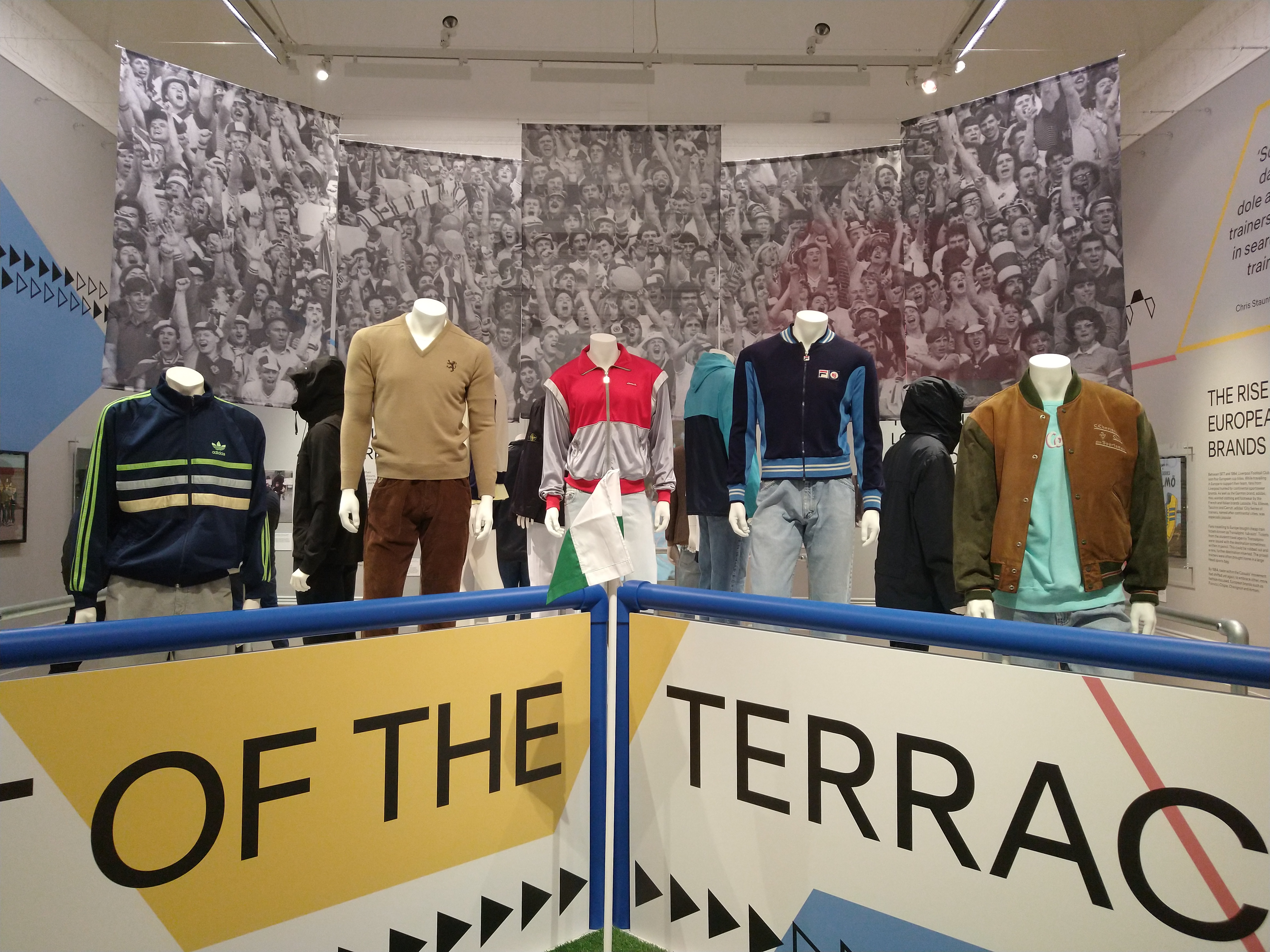
Image of various Mannequins on a terraced display. They are wearing various forms of Casual style fashions. Hung behind are images of football crowds.

Art of the Terraces, Walker Art Gallery, Liverpool
05 Nov 2022 – 12 Mar 2023

“One of the biggest working class youth cults ever but because its home was the football terraces rather than universities or art schools it went largely unexplored by the media.”

This quote from Paolo Hewitt opens the show. The first thing that hits you though is the ‘gang’ of mannequins decked out in some of the iconic clobber of Casuals culture: polo shirts and sports jackets to cords and drainpipe jeans. And of course, trainers – especially Adidas trainers. It creates a strong first impression. Just as it must have done to see a group of lads dressed like this in the street on a grey day in 1981.

Art of the Terraces roots itself in the Casuals subculture that emerged in the 1970s and is the first major exhibition to explore it in detail. As Hewitt suggests, it has gone far less examined compared to other scenes such as New Romantic or Punk which found themselves canonised far more quickly. This despite the fact that the Casuals certainly had a longer lasting impact on everyday dress than many other subcultures.

The first gallery details the emergence of the subculture. The origin of the Casuals is particularly associated with Liverpool FC fans travelling to Europe in the 1970s and 80s. Those fans brought back sportswear unavailable in the UK, drawing attention on the football terraces. Throughout the 1980s, the scene constantly adapted as adherents competed for the best looks, moving into the ‘retro scally’ style, featuring tweeds and collarless shirts, then onto higher end fashion brands like Fiorucci and Chevignon – sometimes to the confusion (and even unease) of such brands more used to selling their wares to fans of tennis and golf. Apparel aside, the fanzine culture that developed in the same period is also acknowledged by the show, including the influential The End which documented the changing fashions of the Casuals. Copies of the more recent Solezine and Girlfans demonstrate some of the contemporary continuity of cultural expression from that era.

Image of a vitrine containing football zines of different eras and magazines and tickets from the early 1980s during the emergence of Casuals culture.

In the second gallery, the exhibition extends beyond the Casuals to a wider exploration of art related to football fan culture from the last few decades. Stephen Dean’s film Volta surrounds your senses on entering. Created from crowd footage taken from across fourteen matches in Rio, it goes someway to encapsulating the feel of being immersed in a fever pitch stadium mass. Frank Green’s detailed watercolours of fans streaming in to Goodison Park and Anfield in the 1989–90 season, meanwhile, capture the period just before changes brought in by the Taylor Report and the Premier League.

Watercolour by Frank Green of Goodison Park 1989-90

Steve Randall’s impressionistic paintings of young Casuals in the Liverpool New Town of Kirkby are particularly evocative. While Ross Muir’s work referencing Vermeer and van Gogh re-appropriates classic art images the way Casuals did with high-end brands. Adidas’s three stripes permeate his paintings as they do in so much of this show, but it’s the penetrating gaze of his faces which stay with you. Muir, like Randall, came to art later in life and the exhibition contains many works by people who might be labelled ‘outsider artists’. Yet, while they may be outsiders to the mainstream art world, they are insiders to the cultures represented.

The exhibition text notes the profound shift in the 1970s in the cities which had given birth to professional football in the nineteenth century, as industry collapsed and with it many of the structures that had defined working class lives. This seismic change saw new working class cultures of expression emerge in the gap created, with the Casuals themselves being a prime example. Jamie Holman’s tapestry Who Are Ya? explores this. The mass workforces of the mills created the audience for professional football. As the mills emptied out, they were re-occupied for warehouse parties by young people. They created a new culture as the working lives their parents had known disappeared.

Image of the 'Who Are Ya' tapestry by Jamie Holman. It is a black and white football crowd scene.
‘Who Are Ya’ tapestry by Jamie Holman

The ‘Coming of Age’ section places the Causals in the context of the decades of youth subcultures that emerged post-World War II in the great age of popular culture, alongside groups like the Teddy Boys and Mods, precursors in the same lineage. In taking clothing associated with more luxurious lifestyles and giving them new forms of meaning, the Casuals were re-writing what was expected of working class young people. As a new consumerist world boomed in the wider culture, even as their own cities declined, this was the response. The desire to ‘look sharp’ and show off when going out, especially when your working life involves wearing a uniform or overalls, functions as a form of resistance to the economic and social status to which you are prescribed by society. This stands in contrast to those from more privileged backgrounds, including those who dominate the cultural sectors, sometimes ‘dressing down’ – either to mask their status or because their sense of security exceeds their need to demonstrate it visibly.

There are tensions and contradictions here of course, as in all youth cultures, including between the desire to fit in and the desire to stand out. These pressures are perhaps also more extreme in working class communities. As the exhibition documents, the Casuals contributed to the development of the now huge designer ‘athlesuire’ industry. As someone whose family had little money and endured grief for only being able to afford ‘shitty makes’, I’m acutely aware of how young people can be made to feel inferior if they can’t pay for such expensive clobber. This wasn’t invented by the Causals, of course, but the platforming of high-end brands in the subculture has had consequences in working class communities. As the cost of living bites ever harder, some exploration of this in the exhibition would have been good.

What is better acknowledged are the issues of violence and racism on the terraces. While the ‘Kick it Out’ section of the show notes that many Casuals avoided violence and acted against racism, the show as a whole doesn’t shy away from addressing football’s issues with them. This is perhaps most powerfully explored in Marcin Dudek’s video works and paintings, influenced by his own experience of finding identity in a group of Ultras. With him turning away from violence after the death of one of his friends. The orange from the linings of the bomber jackets worn by the group he was part of being a constant motif in his work.

Satch Hoyt’s stark Penalty, a human sculpture in a kicking pose made from the black tongues of Puma football boots, was created in response to the continued racial abuse of players. Quoting former player and BBC presenter Jermaine Jenas, the exhibition text notes, “In the 70s and early 80s, bananas were thrown on the pitch at players feet. Now bananas are thrown in people’s emojis.”

The final gallery is dominated by a mocked-up bedroom of a Causal-affiliated teenager which includes one of the stand-out pieces in the show. Tales of Trains to Far-Flung Places – Ordinary to Chelsea by Pastel Castle (aka Emily Garner) is a work in the style of a 1980s computer game, featuring Casuals high-tailing it on a quest around Europe. It has a self-aware wit that seems appropriate as a homage to the era.The exhibition is bookended by Mark Leckey’s seminal film, Fiorucci Made Me Hardcore. This work sums up many of the key aspects of the exhibition, as Leckey reaches back into working class cultures using archival material that was almost lost, weaving it together using the language of contemporary art. A central scene of young lads decked out in colour walking through a housing estate as a voiceover dictates a mantra of Casuals related brands is as if the mannequins that opened the exhibition have become animated.

There’s a risk with a show like this of falling into nostalgia for people of a certain age. But Art of the Terraces is not without contemporary relevance, given the long-term impacts of the Casuals. Football zines have largely given way to fan podcasts and you can now keep your trainers on in the office. The context for the Casuals culture emerging is profoundly different from today’s multimedia world. Yet young people are once again being offered little and having to build something themselves. Hopefully the next phase of influential working class cultural expression won’t take as many years as this one to receive some proper acknowledgement.

This piece was published by The Quietus in December 2022.