Representing Post-Industrial Communities in Culture

By Kenn Taylor

I grew up on Merseyside in the 1980s and 90s, when this region around Liverpool found itself on the extreme end of the UK’s wave of industrial decline in that period. This had a profound effect on my working-class family and community, and it shaped the way I think ever since.

Later, a period of new investment in culture and heritage in the area as a form of urban regeneration, coupled with increasing access to higher education, enabled me to work in creative fields not remotely accessible to my parents.

Yet this very access exposed me to the hollowness of some of these changes. Moving through different kinds of cultural work showed me how few working-class people worked in those sectors, except in the poorest paid service positions. It also made clear why their absence mattered. Rather than representing the experiences of working-class communities, many cultural productions treated them as ‘other’. Too often, they used and patronised the working class.

As I have written in the Journal of Class and Culture, most coverage of post-industrial communities comes from outsiders looking in. Their narratives often veer between relentlessly negative, stereotype-ridden stories and patronising ‘boosterist’ coverage, with all subtlety absent. On the rare occasions when people from such communities get to tell their own stories, they can be distorted by those who dominate and control the platforms where they appear.

My experience gave me an interest in the work of other practitioners who grew up in post-industrial communities had training which enabled them to work in creative fields, and then spent at least part of their energy drawing attention to where they came from. Many of these cultural workers have struggled to ensure their insider perspective is heard by a wider audience.

A good example is the 2021 short film Made in Doncaster by artist and writer Rachel Horne. The Guardian newspaper sent its ‘Anywhere but Westminster’ team to cover the Yorkshire city of Doncaster, and they invited Horne to be a subject of their film. Editor of a long running local zine, Doncopolitan, Horne responded with a challenge: if you want to make a film about the area, we’ll make it together. This attracted a great deal of positive attention nationally and highlighted Horne’s efforts to create a local media voice in the face of the decline of regional newspapers and radio. That decline has made journalism a more elitist trade and reduced opportunities for people living in disadvantaged regions to provide a counterpoint to skewed coverage from national outlets.

The film shows Horne’s determined efforts to feature the voices of people like her and provide visibility for the talent and creativity of the community, not just its problems. As Horne explains, solutions to those problems need to be led from within: “We’re resilient and we don’t need to be patronised. We don’t need experts coming in telling us how to fix things. We want to fix things on our own terms and that’s the way it’s going to work.”

In the film, Horne emphasizes the influence of the 1984-85 Miners’ Strike: “I was born in the miners’ strike. I lived through that whole collapse. It’s not just unemployment it’s like the whole culture went and then you’ve got ten years of austerity.” That influence is also clear in Sherwood, a 2022 BBC drama series created by writer James Graham who grew up in a mining village outside Nottingham, the setting for the series. This powerful drama explores a range of themes, including how all its characters are haunted, one way or another, by the miner’s strike and the subsequent disappearance of the coal industry in the area.

One of the tragedies of my lifetime is that the damage caused by the evacuation of industry without replacement, something once contained to certain areas, has, rather than being remedied in such places, instead gone on to consume much of UK. Sherwood highlights what many in the British establishment have been trying to gloss over and forget since the 1980s. As one of its principal characters puts it, “They didn’t care about us then, the don’t care about us now, they just use us. Look at what they still call us, what we call ourselves. A former mining town. Why? Post-industrial. How the hell are we meant to move on from that when even the way we talk about ourselves is by what we aren’t anymore? How are my grandkids meant to imagine a future beyond that, eh?” The spectre of deindustrialisation haunts Britain.

No other developed country has de-industrialised to the extent that Britain has. And artists like Horne and Graham, who grew up in deindustrialised places, can help us understand what happened and what life is like in these communities now, far better than the misrepresentations projected on to them by others. 

Graham, Horne, and I were able to attend university, where we honed our abilities to probe into and communicate about such things, drawing on direct experiences. The expansion in higher education from the 1960s to the 2000s gave us increased access to power to ask difficult questions and express the complex truths of our experiences and our communities. But such access, especially in the arts and humanities, is now contracting in the UK. In particular at the universities with the highest proportion of working-class students. Like us, young people from such communities today not only have limited local employment options, but they also have fewer educational opportunities.

Both Made in Doncaster and Sherwood contain hope for the potential of working-class cultures and communities in post-industrial areas. That hope comes from the resilience of people in such communities despite everything thrown at them.  It’s a hope though mixed with an ambiguity and a degree of cynicism that comes from having seen so little change for the better at a fundamental level over several decades. If we want anything to improve in future, voices like these must be heard more widely.

This piece was published by Working Class Perspectives in May 2023. It is taken from a paper I presented at the Transnationalizing Deindustrialization Studies: Deindustrialization and the Politics of Our Time (DePOT) 2022 Conference, Bochum, Germany, August 17-20, 2022.

New Brighton


Words by Kenn Taylor
Images by Kenn Taylor and Denise Courcoux

Our Day Out. A place of colour. And what colour. The vivid orange of the Golden Goose arcade. The deep saltwashed blue of the folding RNLI doors. The flaking yellow and green of the New Palace. Its canopied row of smiling plastic signs screaming sugar-sparkling doughnuts, cold ice cream and rubbery hot dogs.

The trilling lights and honking, metallic din of the Bright Spot. Enticed in to feed 2p’s to the ever smoothly rolling pushers in the hope of a tide of copper. Then through to the dark and exciting New Palace with its sparking Dodgems and fast clanking Wurlitzers. The bowling alley next door, even in the 90s still not equipped with computers. Instead, overhead projectors, pencil and paper to score.

Devouring the colour and the sugar. Behind the zinging orange plastic though, the tiredness, the wear, the lack of the New in New Brighton. Growing up in 1980s Merseyside, decay was too often part of the everyday. Eating hot dogs in a shelter long since seen a lick of paint. Watching crazy golf balls loop through elaborate creations scored with cracks and rust. Up the steep streets away from the front, rows of empty shops long before such things became a national concern. The extinguished neon of The Chelsea Reach nightclub. A vague memory of the white walls of a large swimming pool, just before it went to the wrecking ball. The striking tiled finger-pointing arrow outside a shuttered public toilet always staying in the mind for some reason.

This town was built by what we’d call now a property developer for money, borrowing its name from its southern forebear. A segment of the Wallasey. The ‘island of the Welsh’. Out on the edge. End of the line. Tales from my parents of a pier, a ballroom, a ferry, a big funfair and the largest open air pool in the world. Now in place of all that, just a concrete adjunct, a lumpy park and a patch of wasteland. Stories of the Good Old Days I loved as a child, then as a teenager came to resent. The past offered nothing to the young. The present very little. The future was uncertain. This is a feeling that would grow familiar to more and more of the UK as time passed, but back then, it was contained to parts of it like ours. Why was everything so run down, would it ever get any better?

As a teenager the seaside still offers Our Day Out, but with different motivations. The ice cream and the arcades continue to attract, but now we hang out on our own. Looking to the expansive sky and sea. Wondering if our lives can be anything other than what they’re expected to be. Far horizons for people given narrow ones. Enjoyment tempered by a self-consciousness that only illicit access to alcohol can reduce. Then a ride back on the dodgems unlocks something deeper. Watching The Beach, its exotic locations and privileged characters seeming as remote as anything set on an alien planet. Good soundtrack though. We’re told Things Can Only Get Better. The cinema closes soon afterwards. ‘Investment’ gets mentioned in the local papers. Artist impressions of Things That Never Happen or Not Like They Were Supposed To. A record fair in an old hotel makes hearing new albums more affordable. The hotel too closes soon afterwards.

Taking an interest now in broader things. Looking beyond those horizons. Realising with surprise that people from across the globe look at pictures of New Brighton. Taken by Martin Parr. In almost every general photographic textbook published. Those bright colours from memory preserved, even brighter. The yellow sand, the long blue sky. The dripping red sauces on hot dogs and ice cream. The rubbish too, and the decay. All captured for posterity. This brings some joy. How cool is that? A place so close by, captured in the period of my childhood, world famous in The History of Art. But then, beginning to realise that many of the people consuming these images are laughing at us, not with us. That these pictures miss some of the warmth, the fun. What that colour offered to people without the means to travel further. Realising that what they are seeing has been framed in a particular way by an outsider. I begin to understand the power of images. The power of stories. And the power held by the narrow selection of people who control the images and the stories.

Later, I also learn of the New Brighton images of Tom Wood. A photographer who stayed for years and understood the grain of the place. Around the same time, Colin Vearncombe, better known as Black, captured New Brighton rendered in dreamy monochrome in the video for his song ‘Wonderful Life’ directed by Gerard de Thame. Cutting between the dignity and joy local faces and the sheer expansiveness of this corner of Merseyside. The ice white lighthouse against a dark estuary.

An adult, almost. Things Didn’t Really Get Better but They Did Change. The marine lake shrinks and a retail park is built. It has no romance but shops that people use. The swimming pool never comes back. Bad art is installed. A new cinema opens. The theatre for the old folks expands across the ruin of the Crazy Golf. The Chelsea Reach becomes flats. There’s money enough again now to paint the shelters. Things look tidier. The bowling alley remerges with computers. As shelf stackers, we have our Christmas Do in there and someone sides shirtless down the polished lane. We will not be welcomed back. Things are new, but they’re boxy, cheap. The colour seems to have drained away to leave white metal sheds and sheet glass. A thin veneer, like so much was then. A vague attempt at being respectable for those who live in high apartments beyond the station.

Then, almost as if it never left, austerity returns. The dreams of renewal fade. The public sphere withdraws. Things close down. For the want of money, the shelters begin to flake again. Weeds grow tall in cracks. Invest in Property they say. Flats are all that is built. Some of the new shops and restaurants begin to evacuate the retail park as the tide of chainstore expansion recedes.

I live on the other side now. Our Day Out now involves a bike and a ferry and a bike again, along the long promenade from the chemical tanks of Seacombe and past the memorial to those who died digging the cross-river tunnels. Old enough at this point for some of my own nostalgia. This used to be here, this was like that. I cannot say it was better in the past though. I was younger and I knew less. But I know this place deserves more, this world-famous subject of photography. Martin Parr opens his foundation in wealthy Bristol. Across the water giant red giraffes raise up. Seen through the heat haze of the day then starkly illuminated at night. The promise of this estuary being a centre of World Trade again. Waiting for a Golden Goose. When the boat comes in. It hasn’t yet.

I move further away, but return often. Now with my own child. Then a local guy with more vision than 2,000 consultants combined decided things must change. Importantly, he also has the money and time for change. Empty shops re-open. Venues, pubs, markets. People take notice. Murals and street art go up, better than the bad art from the regeneration quangos. People take and share pictures, not of litter, but of painted buildings. The colour returns. There is something New in New Brighton.

Down on the waterfront though, The New Palace, the heart of the promenade, faces demolition. Still not enough money, not enough will. Decay continues to hover in the background. As ever round here, change for the better seems fragile.

This place means more than you can imagine. It is far more than a footnote in art history. It’s still, as it’s always been, Our Day Out.

This piece was published by Caught by the River in February 2023.

Church Valley

By Kenn Taylor

I grew up in a region that was scarred by economic decline and disinvestment. It was a surprise to me as I got older and travelled further that some people thought decaying buildings, places abandoned and boarded-up, areas of wasteland that stayed there forever, were unusual, exciting even.

Sure, I can appreciate the more interesting visual layers to be found where nature is eating away at human effort. But I’ve also experienced how so many places get reduced to just that decay. How the media will pick out declined structures to capture a picture they had in mind before they even arrived, avoiding the dozens of well-maintained streets nearby. Grab a few shots of the shittest alley they can find, then back off quickly to the better parts of London or Manchester to file their story. I’ve seen the power of such stories to distort perceptions and how that can damage people and places.

People living in communities like the one at this crossroads face many issues; a shortage of good jobs, a frustrating lack of amenities and declining public services. Parts of the media though will portray it as if that’s all there is. A litany of decay and despair for their readers to consume so they can feel that, however miserable their lives are, someone somewhere else is living worse than them, so that’s okay. Yet yards from that shitty alley, there are houses and gardens in good nick. Footy banners out. Railings brightly painted. Chalk paint on the floor from kids playing. The buildings which are empty have long faded into the background of everyday existence for those who live here, which might seem strange to those from places where every square foot is intensely capitalised. People have got their corner here, however modest, and they get on with it, despite all that is stacked against them, all that is thrown at them.

This landscape, though, visibly demonstrates the pain that its residents have been through. So much writing on urban life for the past 10-15 years has been about too much growth – too many people, too much construction, too much development. At least the writing from the richest metropolises which dominate the media, arts and academia. Yet that growth never reached many places. Such urban decay is scar tissue in a community whose environment has been wrought time and again by decades of disinvestment and bad decisions by people far away. Political stripes may change, but people still find themselves used or forgotten.

This was and is a working-class community. Unlike the London narrative of gentrification, the environment around this crossroads is what happens when first you take away the economy. Then people start to leave. Then there’s too many buildings that are no longer needed. Then so many of the things which make a coherent, thriving neighbourhood shrink away. As more people leave, especially the young, and aren’t replaced by new incomers, optimism for positive change declines. There are still useful bits of public infrastructure from when various governments had brief periods of largesse, but these are now too often falling apart, shutting and slipping away. ‘Left behind’ is the narrative frequently used for these places, but ‘fucked over’ is more accurate. What happens when a state treats a place as, at best, a problem, more often, with indifference and, at worst, with malign intent.

What was done to places like the community at this crossroads is not all they are. It doesn’t mean though, that people who live here don’t feel the pain this neglect causes to collective and individual psychology. Rundown buildings are the visible manifestation of an experience that burns into the mind of people across generations.

This is what affects middle class writers and photographers when they come somewhere like this. It’s alien to them, what others have gotten used to. When culture seekers and artists are attracted to inner-urban ‘grittiness’, they want visible vibrancy that’s rough around the edges, not people dealing as best they can with unglamorous multigenerational poverty. There’s too much edge for them here, without the soothing balm brought by street art or street food.

Perhaps such landscapes were unusual once, contained to a handful of areas that could be safely written off by the powers that be. These days, this abandonment of people and places creeps into everywhere in the UK, outside the gold-plated parts of the south east, as shops close and good jobs disappear. Now even some well-to-do areas are seeing their high streets decline. You can’t say though that the people who live at this crossroads didn’t warn them, but were told: too bad for you, but it couldn’t happen here.

Yet in the places where the new normal is the old normal, people still go on. Places where neighbours are the same for years, the families often outlasting the buildings in the cycles of clearance. Communities intertwined for decades. More so than in supposedly permanent rural idylls which have long become professional commuter towns. Those who remain somewhere that has dealt with large outward migration tend to be stoic about a place and each other.

What people don’t want in a place like this are more promises of grand gestures of change. Because most of the time, it doesn’t happen, and when it does, it’s usually indifferent to them and has often made things worse. Knocking down and rebuilding endlessly, but never really providing sustained investment in a community or addressing the lack of serious economic opportunities.

This crossroads is an amalgam of the decades: Victorian pubs, New Labour schools, 1980s bungalows, 1970s flats, 1990s petrol stations. It is not a place that’s dead though. It’s a place where the idea of catching a decent break can seem remote, but people go on. Despite the fucking over and the predominant media interest being poverty porn, people do their own rebuilding. The housing co-ops here: communities with well-built houses, plenty of green space and long waiting lists to move in. These sorts of places are often hated by much of the left and right though, neither fulfilling the nostalgic desire to have brave workers gratefully accepting their soaring new concrete wonderhomes from the paternalistic elite who designed them, nor the ruthless Home As Castle acquisition of your own thin slice of Faux Olde England. A working class which has its own ideas about what it wants is horrifying to many. As a result, their successes are ignored, and others don’t learn.

Yet, as local authorities crumble to bankruptcy, government action stumbles over the consequences of the last forty years, and the grass on sites of long demolished buildings grows high and unkept, perhaps now is the moment for those with their hands on the money and the cameras to hand them over. To those who have tried to exert positive change on their patch, despite everything. People who have ideas and skills, though are rarely given the opportunity to exercise them or to control resources. This place is the crossroads the UK stands at. The country has been here before and went a long way down a dark and now thoroughly broken path. The stakes are higher than ever. They need to learn from those who have had to deal with the mistakes of others for decades, and yet who still go on.

This piece was published by the Mechanics Institute Review, Birkbeck College, in October 2022.

Landmark


An essay on a collabortive art project in Sheffield

Words: Kenn Taylor
Images: Shared Programme

Landmark is an art project created through collaboration between artists Emilie Taylor and Christopher Jarratt and eleven people they met at Project 6, a drug and alcohol support service.

On a baking hot day in Sheffield, I meet six of those eleven, Sam, Ben, Ruth, Matt, Lee and Dave. Along with Emilie and Christopher, who details the concept at the heart of the project: “We wanted to map and tell the stories of people’s journeys and moments of great change in their lives through the languages of imagery, colour and craft. Inspired by the symbolism from Sheffield’s past, we settled on pilgrim flasks and banners as the artefacts to hold and tell these stories.”

We meet in the yard of Yorkshire Artspace, with the pilgrim flasks laid out, their glazes glinting in the sun. I ask the group what they thought of these themes when they were presented with them. Lee says, “We were going in blind. But I like history, and the images shown by Chris and Emilie, the references were medieval, so I was quite happy with that. The broader context of us all going on a pilgrimage, that’s what we’ve done through this process.”

Christopher responds, “When we presented it, I did sense some hesitation, understandably so, but everyone got on board. Dealing with hard things in your life, if you can abstract them a bit, I think it helps. Embedding our stories into craft I feel is one of the most ancient and effective ways of making sense of the world.”

They met every Friday over 14 weeks, beginning each session talking about whatever came up for them, then drawing and printing in response. Lee details the impact this process had on them: “The most evocative part, drawing something every week, from our thoughts and feelings, opened up something new. That really connected us, was the glue that tied us in.”

After talking and drawing, they moved to creating objects. For the first seven weeks, they crafted the clay pilgrim flasks. For the remaining seven, they dyed and sewed large cloth pennants. 

Emilie says, “Making the drawings and letting what was under the surface speak could be emotionally deep and very heavy. Moving into material processes offered a way to sit with the weight of feeling in the room. Craft holds space. There were times, I remember dyeing the fabric after very difficult conversations, the mood transformed into all of us having an absolute riot.”

“We had big buckets. We did it as a communal thing,” Sam recalls. They tell me the wind was up the day they did the dyeing. Ruth points to the BBC building behind us, “we had visions of having to go to Radio Sheffield to get our flags back!”

Locations around the city that had significant meanings to individual group members became a focus as the project developed. They decided to dedicate one session to visiting places they’d each chosen. After arriving, they’d share what it meant to them and this was audio recorded. Later, footage was taken of the places and merged with the audio to create a film which forms part of the project.

It’s clear this revisitation of locations which held strong and sometimes painful memories had a significant impact on them. Ruth says, “My place was the Millennium Gallery; I went in again recently. It’s almost like it’s been exorcised from me, through this process. I used to only associate it with bad things, but it’s very different now for me.”

Dave agrees, “Like the park, I have found peace with it now. I go and sit at the bridge and listen to the running water. It’s that journey.”

The film is quietly meditative, its long, drawn out shots of the locations soundtracked by the group members’ heartfelt reflections. It creates an alternative map of the city through the lived experience of these individuals. Ben says of the final film, “Some of it was traumatic, but the sense of recovery and hope, that overrides any of that harrowing stuff. It was very honest, it needed to be spoken about.”

I ask about the images they chose for their flasks and banners. “I drew a wheelie bin full of empty wine bottles,” Ruth explains. “I never realised how much stress that would cause me during my addiction. I like to listen now when they empty my bin, it’s not the nosiest, not the heaviest on the street anymore. But I’d not dealt with that; it was still in there. This has aided my healing, to me forgiving myself.”

Ben says, “The symbols on my flask, I initially described them very matter of factly, they’re just magnifying glasses with eyes. Then someone said they’re quite surreal. And then I talked about how at the time I was under so much scrutiny with psychiatrists, and it links to being under that lens, stigmatised by society.”

Landmark is being exhibited in September 2022, Recovery Month, at Yorkshire Artspace and also on billboards across Sheffield. Emilie links this back to the original concept: “Pennants would have once hung from Sheffield Castle ramparts, welcoming travellers home. The flags of journeys travelled today will hang across the city on advertising hoardings.”

“For me what’s important about the banners being detached from the exhibition,” says Lee, “is if someone is driving past, they’ll be like ‘what’s that’, it will reach a far bigger audience.” The billboards will feature QR codes, to encourage people to find out more. “They will go on a journey with us. There’s a lot more to say,” he concludes.

I ask the group, looking back now, what difference they think the project has made to them. “I have grown and made myself well through this process,” Ben says. “Of course it’s been alongside therapy and other things I engage with, but this has helped no end.”

“I have a friend who has been supportive through my recovery,” Ruth says, “but doesn’t get it, me taking part in a project like this. Why would she. I didn’t get it either, before I came. It’s made me braver, to try new things. My confidence has grown.”

Christopher and Emilie collaborated with an existing community, one whose bonds were forged through the recovery process. Through this, a new temporary creative community was formed. I ask them both if they see initiating this formation as part of their artistic practice, alongside their creative skills. Christopher responds, “In short, yes. I want people to feel empowered and gain a sense of ownership over space and place through learning, skill sharing and creating work with a legacy and an inherent quality.”

Formally trained artists and those not formally trained coming together to share time, skills, knowledges and experiences and create something in collaboration, has a long tradition. It is given many different names, social practice, community art, etc, but the kernel of why it can be powerful is how it can carve a new space for all of those involved.

Exploring and exposing parts of your inner self through making art can be a challenging process. This can contribute to personal development and healing. But in creating these works around their experiences of recovery, the group have also opened up new channels for others engaging with the artworks to reflect on their own lives. Expanding communication across dividing lines. At a fundamental level, contributing to us understanding ourselves and each other better.

Lee says, “I have got hardened to the prejudice and the stigma; I can play out how it is going to go. It doesn’t define me as a person.” Those dealing with addiction, like many with less power in society, so often have their stories defined by others. Having access to your own forms of creative expression, being encouraged and given a platform for them, is essential in people being able to turn that around and speak directly of their own experiences to others. Doing this is a reclaiming of power. And it is partially because of how powerful this can be, that such access to creative expression is frequently denied and discouraged in people, one way or another.

The more you get used to expressing yourself, the more comfortable it can feel. Earlier steps though require bravery and often support. Chris unfolds some of the bright and bold banners that will soon be seen around Sheffield. I ask the group if they plan to carry on their creativity after Landmark. There is a chorus of agreement. Two members of the group have recently enrolled in degrees, influenced by taking part in the project.

“It’s reawakened in me a passion I have always had for art,” Ben says enthusiastically. “I will definitely be continuing the journey.”

Lee agrees, “I have started to write poems again and I have carried that on. It’s a nice creative process for me and I don’t think I would have done that if it wasn’t for this project.”

Dave sums up, “We’re waiting for the next one.”

This piece was commisioned and published as part of the Landmark collabortive art project which took place over eight months in 2021-22. The outcomes from the project where exhibited in Yorkshire Artspace and around Sheffield in September 2022. You can download the exhibition catalouge below.

On cardigans, accents and mis-shapes

By Kenn Taylor

But you don’t sound like you’re from Merseyside?
So you’ve lost your accent?
Did you go to a good school then?

I am tired of these questions. Every one of which is laced with prejudice and projection, even if those asking don’t intend it. Aside from any personal frustration at them, what’s more important is they illustrate some of the skewed perceptions that many middle-class people have in their encounters with working-class people.

Whilst my accent isn’t the strongest going, it is the one I have had my whole life. A mixture, not untypical, of my mum’s Liverpudlian, my dad’s Lancastrian, and me growing up in an overspill estate of Birkenhead—a place where accents range from the strongest ‘Scouse’ to basically exactly how I sound, varying even from door to door.

These questions first came up when I went to university locally in Liverpool and were almost always from middle-class students from the south. Many couldn’t seem to grasp that in a metropolitan area of 1.5 million people, there is both variation and commonality in speech and accent that comes from a complex mix of cultures and migration. This confounded their media-driven expectations about the area and its people. When years later I moved away for work, living all over the country and working for predominantly middle- to upper-class cultural organisations, such questions became even more common, and were often asked after just meeting someone.

I found these questions most often came from people who’d spent the least amount of time in Merseyside, yet considered themselves for some reason to be experts on how people from the region sounded—as well as on what the ‘local character’ was. Many would, without invitation, want to share their thoughts on this with me.

More interestingly, I noticed it became something to challenge me on: ‘But you’re not really a Scouser’, I was told, though this was something I never claimed to be—nevermind that what a Scouser is in reality is pretty ambiguous anyway. Especially when the dockland communities that Scouse culture emerged from were as much in towns like Bootle and Birkenhead more so  than suburban parts of Liverpool itself. As well as this, many dockland communities were moved from riverside neighbourhoods to new towns and housing estates miles inland, often in different boroughs and counties. In short, as those of us with personal experience know, working class and regional identities, accents, and cultures are complex and multi-layered. Many people do not want to engage with this though, because it confounds their comfortable assumptions.

The challenge implicit in this question, of course, is the assumption that being ‘Scouse’ has a particular form and characteristic, an ‘other’ that can easily be defined by someone else based on the signifier of an accent. This challenge was often accompanied by follow-up questions like: ‘So were you middle class then?’ or ‘So you went to a good school?’ I answered, for context, no to both. My dad was a railway fitter and my mum a cleaner and we lived in a working-class community. My dad became disabled and couldn’t work so I grew up largely on benefits, eligible for free school-meals et al. I went to a bog standard secondary modern school and worked for a couple of years before attending Liverpool John Moores University, as the first person in my family to enter higher education. Yet merely because my accent didn’t fit some people’s expectations around class and regional identity, I would often find my experience and identity being interrogated.

After such encounters, I often asked myself why I should have to explain any of this? Why do people feel entitled to ask such prying questions and make such statements, especially in a professional context? When you are usually just trying to respond quickly to the initial common question, ‘Where are you from then?’ why should you have to make the effort to satisfy their curiosity? A curiosity which, in reality, is about whether I and indeed other working-class people and people from Merseyside conform, or not, to their prejudices and assumptions. But you are judged too if you don’t want to respond to such questions or take issue with them. 

All this is a demonstration of the boxes that many middle- and upper-class people put working-class people in: a projection of what they want and expect from working-class people. The working class, it is assumed, have thick accents. Being from Liverpool, it is assumed, means being working class, whereas being from, say York, means being middle class. This is, of course, nonsense. Liverpool has middle-class suburbs, a significant professional sector, five universities. York meanwhile has a working class hit hard by the decline of local manufacturing and high property prices because of tourism and gentrification. However, if you don’t fulfil the stereotypes of what more privileged people consider to be working class or what people from a particular place are like, your identity and culture is questioned by those who have no real experience of it.

Academia and the cultural sector are rife with this. Because class is almost always viewed through a bourgeois lens, it is seen on their terms, as something they can define based on their own prejudices about the dress, accent, behaviour, etc. of working-class people. Some like the idea of having a bit of a working-class presence in their organisations. Yet they often only want and value working-class people who ‘fit the mould’ as they perceive it. That working-class people are as varied and complex as middle-class people, and so are their accents and cultures, is something many do not want to engage with.

This seriously impacts on the opportunities afforded to working-class people and how they are judged and treated within bourgeois and elite structures. Indeed, it even impacts on what stories are allowed to be told within culture. A working-class writer from Liverpool who wants to do something set in the region but whose work is not suitably ‘gritty’ to fit the bourgeois imagination of the place will usually have a hard time getting it told through most mainstream mediums. In contrast, witness the visceral critical reaction to Irvine Welsh’s Trainspotting (Morace, 2001, p.11) when it was first published. In part because it showed a side of pretty Edinburgh that many people, residents and visitors alike, would rather pretend didn’t exist.

There is no better anthem about class, prejudice, and performativity, than Pulp’s ‘Common People’. Its vitriol about an upper-class student trying to act out what they perceived as working-class behaviour because they thought it was ‘cool’, was sparked by someone Jarvis Cocker met at art school—a type of encounter now less likely as arts schools have become further dominated by people from privileged backgrounds (Romer, 2018). It illustrates Cocker’s genius that in a three-minute pop anthem he can say more than most of us in a thousand essays.

Less remarked on, is the also brilliant ‘Mis-Shapes’, from the same album (Cocker et al., 1995): We don’t look the same as you / And we don’t do the things you do / But we live around here too.

This too is an angry and danceable song about being ‘different’ in a working-class context, because being working class is not about conforming to a narrow set of stereotypes set by others: a particular accent, a way of dressing or behaving. As Cocker exudes in Mis-Shapes, being working class doesn’t mean you have to be, as we said around ours, a ‘bad scall’. And of course, there are plenty of bad scalls in the middle and upper classes too.

This issue goes beyond accent. At a conference I attended, talk of class prompted someone to rant about how there were working-class people in the arts, they just needed to throw off the cardigans they wore to fit in. ‘You have nothing to lose but your knitwear’ perhaps? I realised, as they were speaking, that I was wearing a cardigan and considered momentarily, if this made me a reactionary class traitor. Then I remembered that my mum, who spent her working life as a cleaner and in factories, also liked a nice cardi, and  how popular it was, in the  football casual fashions in the North that I’d grown up around, to re-appropriate middle-class knitwear styles and brands—often to the horror and confusion of those who were used to wearing them. Cardigans and class were again just as complex as accents.

Never having had money for decent clothes when I was young, the first thing I did when I got my first decent paying, albeit insecure, job in my mid-twenties was to go and buy a smart overcoat that I’d long coveted. Wanting to look sharp is far from class treachery. And when you have often had little, being able to own ‘something nice’, even if it is singular, can cover up for a lack of security in general. ‘Oxfam chic’ meanwhile is often favoured mainly by those who like to try and ‘slum it’ in the same mould as the student in ‘Common People’ and others who engage in the performance of what they see as being working class. As Nathalie Olah discusses in Steal As Much As You Can (2019): ‘Cosplaying as the working class is one such method used by the middle-class ascendants to the highest ranks of the media, advertising and art institutions. Disguising their own privilege by wearing tracksuits and talking in mockney accents.’ (p.158)

Meanwhile, if you’re rebelling against working-class conventions, which can be just as restrictive and repressive as middle-class ones, then engaging and playing with elite-controlled aspects of culture can be interesting and alluring. Even if you far from swallow them wholesale. As a teenager in the 1990s, I was inspired by the Manic Street Preachers, as they demonstrated that being working class didn’t mean you had to limit your tastes or interests. Nor if you became interested in other things, did you have to abandon popular culture. They showed that grappling with the ideas and the language that is used to control you and turning them to your own ends, is the opposite of class betrayal.

Some view as a burden the feelings of ‘in betweenness’ that can emerge when you have working-class origins but end up with a level of education most working-class people are denied. However, I take the view that these feelings can be powerful. As noted by Lee Crooks (2020) in his abstract for the Working Class Academics Conference:“my capacity to inhabit – and slip between – the environs of the campus and the everyday spaces of the city beyond, I argue, provides a basis for creative transgression, doing things differently and scope for a healthy injection of working-class counter-culture, collective solidarity and humour. At the same time, this feeling of being ‘out-of-place’ and not knowing my place to some extent frees me from the conventional norms and expectations of what a university academic should do and be.”

Something echoed by Chloe Maclean (2020) at the same conference: “a cleft habitus [a feeling that ‘this is not the place for me’] is not solely a site of dislocation, but can be utilised as a resource to challenge the reproduction of hierarchies within an institution.”  

Much of the middle- and upper-class who dominate the culture sector and academia, do not want to grasp these complexities, viewing class as a principally visual and sonic set of signifiers that they can easily pick out and identify. This creates serious issues. As the current push to increase working-class representation gathers pace, there’s a risk that recruiters and commissioners will go for what they perceive to be ‘obviously’ working-class candidates. Excluding those who don’t fit the mould, they might reject a young, working-class LGBTQIA+ candidate who doesn’t have an ‘urban’ accent and doesn’t dress or behave in a way they perceive as working class. This highlights the absolute importance of having working-class people in senior management, decision-making, and commissioning roles in these sectors, not just junior or public-facing positions, or as token artists, outreach staff, or lecturers. As well as this, organisations need to seriously measure the socio-economic background of their workforces and job applicants to identify how representative, or unrepresentative, they are of society. Of course, it needs to be acknowledged that these issues are intersectional and such challenges will be disproportionately worse for people who face other forms of prejudice and stereotyping on top of class prejudice.

Issues around this could also grow now that, like in the 1990s, but in contrast to the last twenty years, being working class is becoming trendy again. Where once ‘chav’ was bandied about as an everyday insult for things not cool, now ‘bougie’ is slung about instead. Where this is dangerous for the working class, is in the inevitability of the adoption and performance of what are perceived as working-class tropes by middle- and upper-class people by those desperate not to be seen as unfashionable and longing for what they perceive as ‘authenticity’. Through this co-option and crass distortion of working-class cultures, we would also see the exclusion of more nervous, more insecure, less supported working-class voices. As noted by Olah: ‘this fetishisation only makes class divisions more entrenched, by further pushing the working-class experience into the realm of morbid spectacle.’ (p. 108) Not only does this deny opportunities to people who are actually from working-classbackgrounds, it reduces their experiences and cultural expressions to a cartoon copy.

Perhaps more optimistically, this change in fashion could indicate a lower social tolerance for bourgeois norms. Yet the trouble about being in fashion is that being working class is likely to go out of fashion again eventually, with an attendant loss of opportunities. It reminds me a little of George Orwell (2013) writing about the anarchist takeover of Barcelona in the 1930s: ‘In outward appearance it was a town in which the wealthy classes had practically ceased to exist … Practically everyone wore rough working-class clothes, or blue overalls, or some variant of the militia uniform …. I did not realize that great numbers of well-to-do bourgeois were simply lying low and disguising themselves as proletarians for the time being.’

Middle- and upper-class people need to be reminded of their prejudices and assumptions, and perhaps in the current climate they’re more likely to listen. Key to change though is ensuring that more working-class people take up space in positions of power in culture and academia. Then there needs to be a constant renewal of this through continued recruitment so that the numbers of working-class people in these sectors grow and expand through their hierarchies. Rather thanjust a token handful of working-class people brought in temporarily when there is a moral panic or it’s found to be trendy, who thenoften find themselves, in their relative isolation, up against a wall of established thought and behaviour. Change must come from outside as well, but without more working-class people in the permanent institutions of culture as well, any lasting change will be much harder.

We have to make sure the new drive towards working-class opportunity and representation truly platforms the working classes in all their diversity and complexity. That it is members of the working classes who get the opportunities to tell their own stories, not have them re-framed, twisted or co-opted by others to enhance themselves.

As it says in Mis-Shapes:
We want the things you won’t allow us
We won’t use guns, we won’t use bombs
We’ll use the one thing we’ve got more of—that’s our minds

This piece was published in issue 10 of Lumpen journal in June 2022

Reference list

Banks, N., Cocker, J., Doyle, C., Mackey, S., Senior, R., Webber, M. (1995). Mis-Shapes. Retrieved from: https://www.azlyrics.com/lyrics/pulp/misshapes.html

Crooks, L. (2020). ‘One of our own?’ On being a working class, hometown academic. Retrieved from: https://workingclass-academics.co.uk/abstracts/#LeeCrookesAb

Maclean, C. (2020). Rise with your class, not out of your class: Auto-ethnographic reflections on imposter syndrome and class conflict in higher education. Retrieved from: https://workingclassacademics.co.uk/abstracts/#ChloeMacleanAb

Morace, R. (2001). Irvine Welsh’s Trainspotting: A Reader’s Guide. London, England: Continuum.

Olah, N. (2019). Steal as Much as You Can. London, England: Repeater.

Orwell, G. (2013). A State of Affairs Worth Fighting For. Retrieved from http://bookanista.com/orwells-spanish-civil-war/

Romer, C. (2018). Specialist arts colleges are among the most elitist in the country. Retrieved from: https://www.artsprofessional.co.uk/news/specialist-arts-colleges-among-most-elitist-country

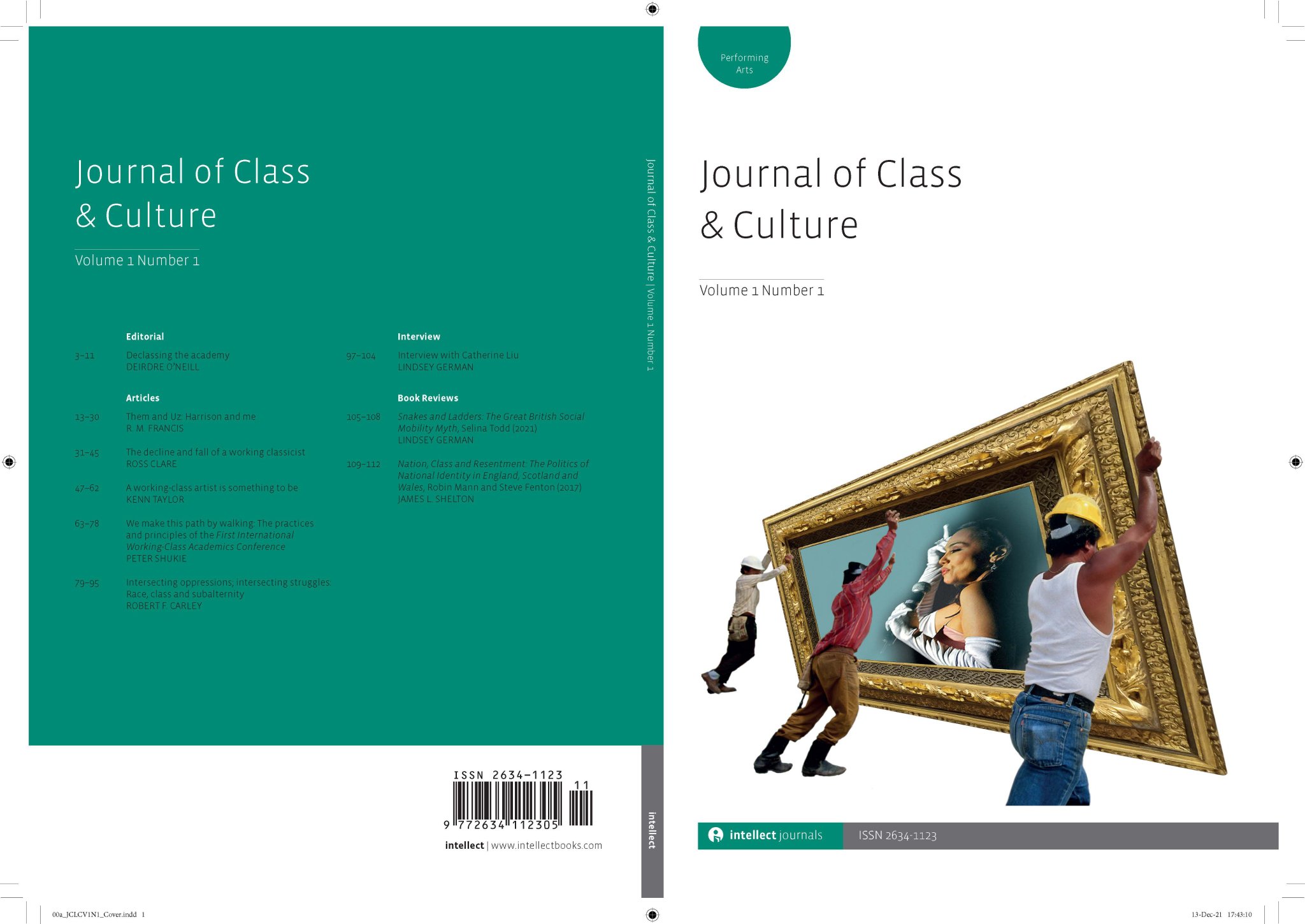
A working-class artist is something to be

Cover of Journal of Class and Culture, Volume 1, Number 1.

By Kenn Taylor

Abstract:
The creative and cultural sectors in the United Kingdom largely exclude the working classes. Even the small number of working-class people who do ‘make it’ into these sectors often find themselves and their work badly treated by those who hold the real power. This article explores some of the experiences of working-class artists navigating the cultural sector and how exclusion, prejudice and precarity impacted and continue to impact them. It takes as its focus the filmmaker Alan Clarke and the playwright Andrea Dunbar, who were at the height of their success in the 1980s. It also considers the writers Darren McGarvey and Nathalie Olah, whose work has achieved prominence in recent years. It is through this focus I hope to demonstrate the long continuum of challenges for working-class creatives. This article also considers how, on the occasions when they are allowed the space they deserve, working-class artists have created powerful shifts in cultural production. Finally, it details some of the changes needed for working-class people to be able to take their rightful place in contributing to cultural life and the societal risks involved if they are denied that place.

The full essay can be downloaded from here.

This essay was published in Volume 1, Number 1 of the Journal of Class and Culture in December 2021.

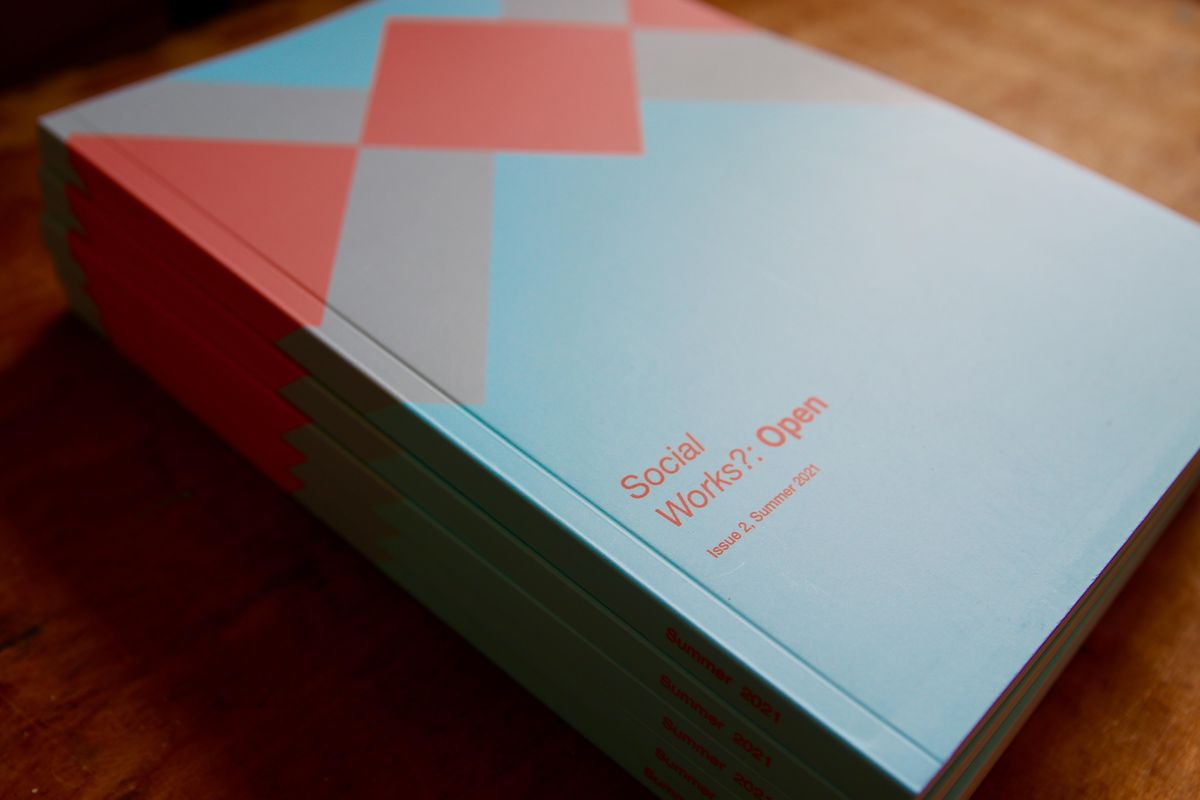
Community and Complexity in Social Practice

Cover of Social Works?: Open Journal Issue 2.

By Kenn Taylor

My involvement in social practice stems directly from my own experience. I grew up largely on benefits in a working class, Catholic community in Merseyside and was the first in my family to go to university. When I started working in the cultural sector, I soon realised that there was a huge gulf between the sector and the background I came from, and this drew me to community practices.

Initially I was mostly engaged in projects in working-class areas of Liverpool and shared much of the same history and ‘cultural memory’ with the people I was working with. This often made building connections easier, but I was also acutely aware of how differences—even minor ones—for example, between districts, generations, religions etc, could mean very different views of even shared experiences. I quickly learned that you had to stand back from your own positionality as much when working within your ‘own’ culture as you did when working with communities of different backgrounds or experiences.

The idea of ‘community’ is something often viewed by bourgeoise cultural institutions and practitioners as inherently positive, particularly as some experiences and understandings of ‘community’ have shifted and changed. This can lead to a romanticised, if not patronising, view of some communities; one that can result in ‘othering’ even if unintentionally. Being from the background I was, it seemed obvious to me that while being part of a particular community can be supportive, powerful and culturally rich, it can also be oppressive, exclusionary and constrictive—sometimes simultaneously. Communities sometimes define themselves in opposition to others and the suppression of difference and conformity that community membership may require can be difficult for many. This can be the same for the communities that people become part of later in life, as well as the ones they are born into. As some concept of community is often at the heart of social practice, these complexities need to be opened out and considered at funding, policy and practice levels, not glossed over or ignored.

Later when I left Merseyside and worked with many more different communities, I came to understand further what an ‘outsider perspective’ could also bring to social practice. However, I still found that sharing some experience of being from a community traditionally excluded from cultural institutions, helps in learning how to navigate the intricacies that such work involves. It is vital that organisations develop this knowledge and experience at a management level as well as in delivery, so that it permeates throughout their systems and interactions with different communities. Employing people with lived experience is, of course, not a panacea for good practice, but it can make it easier to create spaces where the knowledge and experience of an organisation as well as the community they’re working with can both be acknowledged and considered in a way that can challenge entrenchment by either side. Cultural organisations that are still very dominated by the sector’s ‘somatic norm’[i] of white, middle-class workers may find this much harder. 

In spite of its complexities, working at the intersection of cultural organisations and wider communities has often been very rewarding and taught me much more than working in a purely institutional context ever could. By recruiting people with shared experience of who they’re collaborating with and by seriously engaging with these issues in social practice, we might find we achieve more powerful outcomes.

This piece was commissioned and published by the Social Art Library in September 2021.


[i] O. Brook, D. O’Brien & M. Taylor, Culture is bad for you: Inequality in the cultural and creative industries (Manchester: Manchester University Press, 2020), p.191-200.

Changing cultures: class, place and cultural institutions

By Kenn Taylor

In the 2000s there was a boom in new cultural facilities opening in the English regions, often in places whose economies had struggled since the 1980s. Many of them subsequently had significant challenges connecting with local audiences. Most of these new facilities were based around a particular model of art and cultural consumption that had its centre in London and other global megacities. Such organisations, when they opened, largely employed in their senior roles white middle- or upper-class people who were drawn from elsewhere and who often shared remarkably similar career backgrounds.

Nevertheless, some junior jobs were created in such places. I began my career in one of them in my native Merseyside on a zero-hours contract. Despite being passionate about art and culture, I soon became alarmed at how such organisations often seemed more focused on recognition from their peers than from the communities they were based in; as well as a wilful lack of acknowledgment that inequalities existed within and outside such institutions. Experiences such as these drew me to work in what was then called community arts, a field which seemed to at least try to address the relationship between key practices in culture and wider society.

Much of course has occurred since. Such community practices, once written off by the ‘mainstream’ cultural world, are now seen as part of the fore of contemporary culture. Class, for a time dismissed by many as irrelevant, has come back to bite.

There has also been a move away from that previous model of cultural development in the regions, with programmes such as Creative People and Places (Arts Council England) having shaken up things up a little. Yet much more needs to be done. Too many organisations still fail to employ people from working-class backgrounds and from the communities they’re based in, especially at management level. Even now, many organisations still struggle to seriously engage with many communities and cultures.

While class is our focus here, it is important not to privilege it over other inequalities. Nor by taking about organisations engaging with local cultures do I mean separating out the ‘white working class’ or a specific requirement to have been born somewhere. Class has had renewed attention recently, partially because it was almost written out of the conversation for 20-30 years. Notably it was removed from 2010 Equalities Act upon its introduction into legislation.1 Yet we must be careful not to fall into the rhetoric of divide and conquer when it comes to change in the cultural sector. I refuse to allow the exclusion of those from my socio-economic background as an excuse to further marginalise working-class people of colour who face even more barriers.2

The cultural sector more seriously engaging with class and regional identity is at its heart about social justice. It is also, though, about making cultural organisations more effective and sustainable. As is well established in business studies, having personnel from diverse backgrounds is a powerful driver in creating more successful organisations of all forms.3 Perhaps none more so than in the sector where culture is both the main input and output, and new ideas and perspectives are often vital to success.

Yet, as evidenced by an array of research and demonstrated in rigorous detail in the 2020 book Culture is Bad for You by Brook, O’Brien and Taylor the majority of the cultural workforce is still drawn from narrow sources and it remains one of the most elitist areas of work.4 This has real impacts on the culture that is produced by the sector, which in turn significantly impacts on how society views itself. Some of these inequalities are structural and beyond what the cultural sector can change in itself. However there remains much that the sector can do.

Currently the vast majority of culture workers have similar entry routes via university. While this works for many, to increase diversity in the sector we need to create more varied forms of entry. Requiring a degree is a class barrier in itself, especially as higher education has become more expensive. That divide is further widened for those who have to work alongside studying, to support themselves. There has been a positive movement away from unpaid internships in the sector, but some still remain and these are a major obstacle for those who can’t afford to work without pay.

Increasing school and college leaver entry into employment into cultural organisations is vital. There has been a growing array of initiatives for this, though the way apprenticeships were reformed in recent years has made it harder for some smaller cultural organisations to access them. However, too often things fall down in how staff are developed after they take up such entry-level roles. There need to be serious career development pathways put in place, especially in medium and large cultural organisations, where people can start as an apprentice and work their way up to senior management, especially in the ‘creative’ side of organisations where this is most often lacking. We need to develop sustainable routes to entry, including those with part-time study alongside on-the-job training, which is common in other fields, for those who cannot, or who don’t want to, take the full-time student route beforehand.

A new model needs to be cultivated where people can develop their career both within organisations and within a region. This is especially important outside of London, where even the largest cities only have a modest number of cultural organisations and jobs and so the tradition is for key management and leadership positions to be taken by highly mobile people from elsewhere. Currently, to not move about like this is to significantly reduce your career options. This is something I had to face when, having spent my whole life in Merseyside, it became apparent to me in my late 20s that unless I was prepared to work in other places, I would hit a career wall, so I spent several years moving around. While this had many positives, it also meant losing connections with family and friends as well as much financial strain. At a structural level of the cultural sector, this reduces opportunities for development for locally based candidates. It also undermines the depth of local engagement by institutions, as personnel move around and constantly have to acquaint themselves with new situations.

Those who grow up in a particular place, even if they have lived away for a time, tend to be more rooted in its stories, its cultures, its complexities and its contradictions. Thus their understanding of audiences can be much more enhanced. It’s also vital for younger participants and junior staff to be able to see someone who is from a similar background to them in the top positions when they are starting out — both in terms of class and regional identity. This is not to ignore that there are also benefits of having worked in a few different places, for staff and the organisations they work for, but to argue for the need for more plurality in how people are recruited and developed in the sector than now. Of course, being from somewhere in the regions and being working class are not one and the same, but class and place have particularly important crossovers in the regions, in terms of access to opportunity, mobility, experience and connections.

Recruitment processes also need to take better account of socio-economic diversity. For example, removing the qualifications requirements for jobs unless they are actually needed and taking account of the challenges to career development that people may have faced due their backgrounds and circumstances; with cultural institutions taking up opportunities to collaborate with specialist organisations who can help with diversifying recruitment. As well as for staff, the same goes for the recruitment of artists. This means enough open application opportunities, but also enough direct support for artists to apply who may have less confidence and experience, including ‘payment for pitching’ when appropriate.

The need to recruit artists from diverse backgrounds is even more acute in collaborative projects with communities. Too often artists from middle-class backgrounds are commissioned to engage with working class communities. While this meeting of different experiences and ideas can be powerful, just like with management of cultural organisations, it reinforces the idea that a certain type of person gets paid to make culture and lead projects. While of course having similar backgrounds does not always result in equivalent understanding or equal power relations, some shared experience between an artist and a community they’re working with does tend to make the navigation of such intricate relationships easier.

It’s important not to fall into the trap of thinking working class = better, as comfortable as it can feel given the unequal relations across the class sphere and the long tradition of dismissal of working-class cultures. This can be inadvertently patronising. Power, space and support is what working-class people need in the culture sector, not sympathy or awkward deference. I’m proud of my working-class background, its richness, vibrant culture and energy, but aspects of it, like all cultures, had its share of prejudice, narrowmindedness and exclusion. Employing and platforming working-class people and those from other structurally disadvantaged backgrounds helps create the conditions to tackle these issues and complexities in culture, because they have the direct knowledge and experience to do so. However, this then has to expand back out beyond specific projects to impact the wider operation of a cultural organisation, its relationship to its audiences and how it communicates its work.

One of the biggest issues stemming from the lack of diversity of those employed in the cultural sector is how this helps generate a kind of shared perception of ‘how things should be done’ and of what has value. Shifting organisations away from this is vital for change. That is not about completely abandoning professional practices built up over years, as these are often hugely effective in creating powerful culture. More, it’s about how cultural organisations, especially those distant from the biggest centres of cultural production, take on board what happens when their established knowledges and practices meet and intersect with different forms of knowledge and experience. I think of a quote from the Turner Prize-winning artist Mark Leckey, who grew up in the same area as me, upon his retrospective exhibition at Tate Britain in 2019: ‘This is the world I belong to now. But at one point I belonged to another intelligence.’5

The current model places institutional ideologies and practices, which may cross national borders but tend to be governed by particular classes throughout, way above other perspectives, and this is increasingly being challenged. When a space can be created where different types of experience and intelligence can respect and acknowledge each other and find crossover, that is a really interesting place from which many great cultural productions have resulted. This goes back to the traditions of things like Augusto Boal’s Theatre of the Oppressed6 but such thinking is now expanding into other forms of culture and I feel we’re just at the beginning of it.

Now more than ever, cultural organisations need to reconsider their traditional value and production systems, to be more responsive, more dynamic and distribute resources more evenly across all forms of programming; not just in terms of financial investment, but how things like time, space or personnel are allocated. If organisations are to be more engaged with the places they are based in and attract a wider range of people, a focus on a constant stream of big productions which need large audiences and significant media attention to justify them, is not always the best method. Projects at scale can be powerful, inspiring and popular, but often take up so much resource that other forms of programming can be held back. Allocating resources more evenly and working in a way so that the often artificial barriers between ‘types’ of cultural project are broken down would allow for a greater variety of more innovative and open-ended programming. This will also benefit less experienced employees in being able to lead their own projects at an earlier career stage and work with less experienced artists and practitioners, meaning organisations can invest more of their resources in new voices. Crucially, this will also aid those who enter the cultural sector from more diverse backgrounds in not being siloed into particular areas of work just focused on community engagement, so they are able to bring their ideas and experiences to influence across an organisation’s work.

Of course, any form of programming takes up resources and doing ‘lots more’ might not automatically result in more depth, more diversity or better relationships with communities, but rather in exhaustion and even audience fatigue. Yet as we need to look hard at how cultural provision is done, stepping back from the current model could mean that new and more diverse forms of programming can emerge in the space that is created. In doing this, some organisations will need to shift their focus from getting validation within their particular field to gaining recognition from the communities which surround them. Yet the two need not be mutually exclusive. Doing work more rooted in particular places can often create more original programming that in turn attracts more critical attention and wider interest, rather than merely replicating the sort of bourgeois contemporary culture that can be found all over.

Some argue that current cultural organisations need to be replaced entirely. The fact is, people have been calling for the traditional academies/museums/theatres etc. to be abolished for almost as long as they’ve existed and it never happens, rather they change and adapt under new influences. Even new and radical organisations, if they don’t burn out, have a tendency to solidify and become ‘institutions’ themselves soon enough.7 While funding should certainly go to new and different organisations and new cultural forms, this doesn’t negate the need to change existing ‘pillar’ organisations to make them more relevant to contemporary life, because they’re not going anywhere.

There are also arguments that too many resources have been put into buildings rather than programmes over the past couple of decades. Yet we should also not forget how many cultural facilities have also closed in recent years, in particular those in more underinvested towns and cities. Many people live a long way from good quality facilities where they can create or experience culture. Buildings are not bad in themselves, it’s about the right type of buildings being used in the right way to meet people’s wants and needs. If you find your building doesn’t fit your organisation’s mission, change the building, not the organisation.

In the regions the largest cultural funders were traditionally local authorities,8 however, many of them now struggle to do this. Thus as culture has become something increasingly set, defined and funded by people based in the largest cities, this has perhaps added to the alienation felt by some people from the cultural sector. Especially as cultural provision in smaller towns and cities and rural areas has in many cases become increasingly vulnerable if not closed completely. By changing how cultural funding is allocated and distributed so more power is put into the hands of the people in the regions themselves, they could better allocate resources to meet complex local structures and needs.

A not dissimilar feeling of alienation is often felt by working-class people when they enter the cultural sector and find organisations, even ones they are passionate about, have an awkward relationship with people from their background. If supported, they can be positive agents of change. Yet for now, as it says in Culture is Bad for You: ‘Those who have the most insight into the problems are often given the least power.’9

This is a process of both short and long-term change. As someone from a working class background who now has a relatively established position in the cultural sector, like many others I can bring a particular perspective that can hopefully contribute to this. Yet, getting a handful of working-class people into positions in the cultural establishment is not enough. There needs to be a pipeline created to ensure there is a constant renewal of people from diverse backgrounds, including socio-economic, entering the sector, and crucially, developing in and changing it.

Given the huge tectonic shifts presently shaking the very foundations of many cultural organisations, if more do not change faster, they will struggle. If the sector embraces some of the above though, it could become more sustainable and produce forms of culture that engage a wider diversity of people. It could also contribute more to our contemporary communities, encouraging greater understanding of our society, the issues it faces and changes we need to make.

This essay was published in Engage Journal 45: Class and Inequality in July 2021.

Notes

  1. D. O’Neil and M. Wayne (2018), ‘Putting Class Back onto the UK’s Equality Agenda’ in Open Democracy, 14 January 2018, https://www.opendemocracy.net/en/opendemocracyuk/putting-class-back-onto-uks-equality-agenda/ (Accessed 6 February 2020)
  2. O. Brook, D. O’Brien and M. Taylor (2020), Culture is Bad for You: Inequality in the Cultural and Creative Industries. Manchester: Manchester University Press, p.65
  3. Eswaran, V. (2019), ‘The Business Case for Diversity in the Workplace is Now Overwhelming’ in World Economic Forum, 29 April 2019, https://www.weforum.org/agenda/2019/04/business-case-for-diversity-in-the-workplace (Accessed 4 February 2020)
  4. Brook et al. (2020), op.cit.
  5. Leigh, D. (2019), ‘Mark Leckey: From Art World Outsider to Tate Britain’ in Financial Times, 20 September 2019, https://www.ft.com/content/7c15167a-d897-11e9-9c26-419d783e10e8 (Accessed 6 February 2021)
  6. Actingnow.co.uk, ‘What is Theatre of the Oppressed?’, http://www.actingnow.co.uk/what-is-theatre-of-the-oppressed/ Accessed 6 February 2021
  7. Cranfield, B. (2016), ‘It Should Not Be to Its Past that the ICA is Beholden, Rather the Needs of the Present and Future’ in Apollo, 31 October 2016, https://www.apollo-magazine.com/past-ica-present-future (Accessed 6 February 2021)
  8. Hill, L. (2020), ‘Let Councils Lead On Arts Funding, Says New Report’ in Arts Professional, 7 September 2020, https://www.artsprofessional.co.uk/news/let-councils-lead-arts-funding-says-new-report (Accessed 13 February 2021)
  9. Brook et al. (2020) op.cit., p.51

Culture Shifts: urban growth, decay and art in the post-industrial city

By Kenn Taylor

Birkenhead was built around a shipyard, Cammell Laird. When I was nine years old it closed down. Our school was taken to the yard as the last submarine built there was launched. As we waved our little flags, we had little understanding that we were effectively waving away the local economy and our own future. That year, 1993, male unemployment in some parts of Birkenhead was 52%. Our town just a microcosm for the wider region around Liverpool, which faced huge challenges of economic decline and all the negative social impacts that cascade out from that.

What is the point of a shipbuilding town, or any kind of place, when the economic or strategic situation that brought it into being no longer exists? What happens to the culture of a place and its people when it is left to rot? Urban areas have always been the cradle of art and culture. These are also amongst the few things left when urban civilisations throughout history have collapsed. If culture is all somewhere still has, can a place survive on it?

‘The logic that created the city also destroyed it.’
Yves Marchand & Romain Meffre[i]

As long as there have been cities, they have attracted artists. In fact, the professional artist, distinct from a member of a community who makes art only as part of what they do, is dependent on a wider superstructure to support them. To be a professional artist, someone, somewhere else, has to be growing the food, generating the energy, erecting the buildings and removing the rubbish.

With the rise of industrialisation from the 18th century onwards, nouveau riche cities that grew rapidly powerful on the back on industrial wealth were earnest to stress their cultural credentials by funding artists and major cultural buildings. Such buildings often adopted Neoclassical styles inspired by the ruins of the ancient urban civilisations of Rome and Greece. These new cities viewing themselves as the heirs to such power and culture. Aping Rome, Liverpool even wrote SPQL in its grand civic hall’s metalwork, such was the imperial confidence. These buildings were often built far from the factories, docks and warehouses that paid for them, industrial cities and towns wanting to avoid notice of the grime and ‘unsightliness’ of the very things that made them rich. Indeed, while some artists of the industrial period celebrated the rapid changes taking place, most initially sought refuge from it. Seeking out in their art an alternative to the dark satanic mills and the poverty of the over-populated city. These artists favoured the romantic ruin, the rural idyll, the ‘lost beauty’ of pre-industrial times, like the Pre-Raphaelite Brotherhood, a movement which ironically found favour with rich industrialists in Britain’s urban North. This would not be the last time that an artistic protest against social and economic change ended up being consumed by those who were at the heart of such change.

In the later 19th and early 20th century, the movement against the urban blight and poverty begat by industrialisation grew. Figures such as William Morris and John Ruskin were influential in inspiring the likes of the Garden City movement. This, along with the development of public transportation and technological changes, led to an increasing movement away from industry and human habitation in the inner-city.

After WWII, a range of factors formed a pincer movement against the industrial city. Businesses wanted new, large single-storey industrial buildings, with ease of vehicle access and parking, close to new motorway networks. No longer brick multi-storeys near railway and river. Residents began to leave too. Where suburban rail lines led in the first part of the 20th century, the rise of the car accelerated the trend. Once only the wealthy could have their ‘house in the country’ and still get to a place of work, now this was open to many more people. Rising incomes, easier access to mortgages and record house building saw a trickle become a flood. Some people were forced to move though. Many architects and artists were desperate to make the world anew after the horrors of the two World Wars and the Great Depression. They saw the only possibility of getting away from such corruption and destruction in urban areas was pretty much starting from again from scratch: creating new urban areas along more ‘rational’ lines after mass demolition. With such Modernist planning ideas reaching their zenith in the mid-1960s, the development of New Towns and vast overspill estates far away from the centre saw a large inner-city exodus. With housing in inner urban areas often being replaced with high rises, further breaking up older urban patterns, their structures and communities.

By the late 1960s, all these shifts had created vicious circles which sucked away people, activity, wealth and power from central cities. Expensive infrastructure and services that had developed over decades became ever harder to maintain with the declining tax base that came with people and organisations moving away. This was starkly illustrated in the population changes of post war cities. From Detroit’s population height of 1.8 million in 1950 it is now down to just 700,000. Liverpool’s population meanwhile shrank from its 1939 peak of 857,000 to 439,000 today. In 1939 the population of inner London was 4.4 million, by 1988 it was 2.5 million. In 1980 New York City’s population had dropped a million from a decade before and the city narrowly avoided bankruptcy in the 1970s.

The solutions proposed to arrest this decline were again heavily reliant on Modernist planning ideas. The future of these inner cities, it was said, was for large, office-based businesses, while the remaining urban population were condensed into housing blocks. So huge new office complexes were built. Examples include the Renaissance Centre which today dominates Detroit’s waterfront, and the similarly grandiose but never built ‘Aquarius City’ office complex in Liverpool, which would have seen the now Grade I listed Albert Dock complex razed for it. However, as the western economy declined into the 70s, the funding and demand for such schemes dried up, leading to pockmarked and devastated urban areas and remaining populations with few employment opportunities.

Jane Jacobs’ book The Death and Life of Great American Cities critiqued what had by then become orthodox planning, noting: ‘This is the most amazing event in the whole sorry tale: that finally people who sincerely wanted to strengthen great cities should adopt recipes frankly devised for undermining their economies and killing them.’[ii] Jacobs was incredibly influential in getting wider society and those in power to take a different look at the qualities of the older, inner-city. However, her passion and those she inspired, for such areas and their communities, would later have malign consequences around gentrification and development that Jacobs and her followers did not foresee. Or perhaps wilfully ignored, because of the role they played in them.

There was a point in the 1970s when London, Liverpool, Detroit, and New York all seemed to be on a roughly similar path, but from the 1980s there was a strong divergence between cities who re-forged a new base of existence, along finance and creative capital, even if it didn’t offer a new future for all these cities’ existing residents, and those cities who found it harder to adapt to the growing Neoliberal, ‘post-Fordist’ world.

‘Through its complex orchestration of time and space, no less than through the social division of labor, life in the city takes on the character of a symphony: specialized human aptitudes, specialized instruments, give rise to sonorous results’[iii]
Lewis Mumford

Art and culture in industrial cities was traditionally bankrolled by either the city’s authorities or its wealthy industrialists, who were frequently one in the same, This was usually limited to ‘high culture’, with ‘grassroots culture’, consumed by those working in the factories, warehouses and dockyards owned by these industrialists, often existing on its own terms. This culture was paid for by its mass popular base rather than by a small number of wealthy individuals. Thus, the industrial city had two aspects of artistic production supported separately by its small number of very wealthy individuals and by its large, mostly poor mass.

Often there was artistic and social tension between these forms of artistic patronage. Just as the United Auto Workers were gaining strength in 1930s Detroit, Edsel Ford was sponsoring Communist-sympathising Diego Rivera to paint his Detroit Industry Murals. At the other end of the spectrum, occasional autoplant worker Berry Gordy later used his experience on a production line to influence the creation of Motown Records’ system of ‘hit’ production. In Liverpool meanwhile, dominated by its vast port, the arrival and departure of many different sailors brought musical influences from around the world, especially the US, helping to influence the sound of Merseybeat and The Beatles.

It was this flux between large, diverse mass populations and a relatively small number of extremely wealthy individuals that helped produce the vibrant cultures of industrial cities. But the gulf between these two parts of society fuelled increasing tensions between them, which were played out through the 20th century. The 1960s would see the start of a decisive break in culture, cities and industry. Merseybeat and Motown were at this time reaching their peak, their global influence far outreaching the impact of all the ‘high culture’ that industrialists had bankrolled in their respective cities the whole century previous. These Black and working-class, marginalised cultures, rooted in the cities they were created in, ended up far surpassing in importance the elite’s version of art in their host cities, so often based in replicating the past of other places and cultures. Yet even as this was happening, Liverpool and Detroit were already on the path to their economic decline. The increasing power, wealth and leisure time of the mass working class which helped fuel these scenes was also reaching its peak before it began to fall.

By the late 60s culture and artists were frequently seen as having a dangerous power by those in charge of increasingly challenged and struggling city authorities as the power of the patrician elite began to decline. The actions in Paris in 1968 were the most famous, but London too was rocked by art school occupations and anti-Vietnam and anti-nuclear protests. In Detroit the devastating 1967 riots were a key turning point in the city’s fortunes. In 1970s Liverpool, the city already by then desperate to develop its economy, gave little opposition to The Cavern Club being demolished by British Rail for a new underground line. Both Liverpool and Detroit becoming globally known for their vibrant music, which replaced their previous reputation as centres of industry, transitioned quickly to them being seen as bywords for economic decline and urban decay.

All this went in tandem with the continued thrust by civic leaders in the virtues of Modernist planning, but with diminishing returns and increasing opposition. In these cities, like many others, hard drugs like heroin and later crack cocaine began to flood into deprived and desperate communities with an attendant rise in street gangs and crime. This in turn saw even more people and businesses leave and more urban decline. The city, many declared, was dead.

Yet, it was in this very atmosphere that some inner city cultures began to flourish. In New York, unwanted tenements and industrial buildings began to be utilised as new spaces by creative people making new forms of art, exemplified by Andy Warhol’s Factory. Clubs like CBGBs developed in run-down parts of the city, with Television, Talking Heads and Patti Smith emerging as New York sailed towards bankruptcy. Detroit had the MC5 and Iggy Pop. Eric’s nightclub in Liverpool helped birth bands like Echo and the Bunnymen, Frankie Goes to Hollywood and The Teardrop Explodes. Hip-Hop and the culture surrounding it grew, generating interest globally even as New York’s leadership despaired about the ever more elaborate graffiti covering its run-down Metro system. The very fact that parts of the centre of New York were so empty made it a magnet for people who were not accepted or couldn’t afford to live elsewhere.

In Detroit and Chicago meanwhile, the empty factories and warehouses made redundant by industrial changes became home to flourishing dance music cultures, House from Chicago and Techno in Detroit. This in turn found favour in the UK, with clubs emerging in the abandoned industrial spaces of Liverpool, Manchester and London and rave culture finding popularity amongst their disenfranchised and unemployed youth.

In the late 20th century the inner city was a place of tension, decay and poverty, but it was also the cradle of change. Far from being dead, the spaces left by the receding economic tide became home to some of the most cutting edge aspects of global art and culture. Yet, in many of these cases, those in charge of these cities did their best, not only to not sponsor, support or even cash in on this, but to shut it down. The pop culture flourishing that saw the birth of Motown and Merseybeat, while initially being seen as harmless and positive, began to upset the status quo and subsequent radical cultural outputs were treated with concern and often hostility. Being targeted more often than not with enforcement action by local authorities and police. But as the hope for Modernist style mass renewal began to fade and crumble, a different perspective slowly began to grow. As the old dense urban landscapes were being swept away. Because of the very fact they were disappearing and were associated with radical, even dangerous, culture, such landscapes soon began to attract a new generation, the children especially of those who’d for one reason or another, left such places for the suburbs. 

What would start to save these cities, it began to seem, was their radical cultures. Something which could have only reached its peak as the contradictions inherent in these places began to cause their decline.  

I find myself back in Stanley Dock, the huge, crumbling warehouse on the edge of the city. When I was a kid my dad used to take me to the rough and ready market held in it so he could buy ‘second hand’ tools. What brings me here over a decade later is a party for the Liverpool Biennial art festival. There’s free booze, good music, dancing. Having grown up wanting to be part of the creative world, but worried I might never be able to, it feels good. I end up chatting to an arts person who isn’t from Merseyside. They say: ‘It’s great that Liverpool has all these abandoned buildings you can do stuff like this in.’ This sentence sticks a little in my craw. On the one hand, who doesn’t love a party in an old warehouse? But then, to not realise while abandoned buildings are fun and adventurous for some, for many more who walk past them every day, they’re not exotic or interesting or an opportunity. They’re tragic. Palpable symbols of decline, of lack of opportunity, of deep-rooted decay. But hey, it is a party, I go back to dancing.

‘The Birth of Gentrification’ by Lees, Slater and Wyly, describes succinctly the change in how such urban places were perceived by a new generation from the 1960s onwards: ‘In both the United States and in Britain, post-war urban renewal meant the bulldozing of old neighbourhoods to be replaced by modern housing and highways. As the destruction spread, so did the rebellion against it. In the beginning the protesters were mainly historians and architecture buffs, but slowly these were joined by young, middle-class families who bought and lovingly reconditioned beat-up, turn-of-the-century houses in ‘bad’ neighbourhoods.’[iv]

One of the roles of artists from the industrial revolution through to the post-industrial one has been that of highlighting the value of things which wider society has discarded. Those in the Romantic movement in the 19th century wanted to highlight the beauty that they saw was being lost in the fields and hamlets and small workshops, the long-established ways of life being swept away by industrialisation. While the artists moving into New York’s emptying loft buildings and London’s decaying docklands in the later 20th century also wanted to reflect and argue for the worth of such places and cultures that had been written off as economically unviable and of the past.

As documented by Sharon Zukin in Loft Living: Culture and Capital in Urban Change[v], art and artists played a particular role in the development of gentrification in decayed urban areas. The ‘character’ and relative ‘wildness’ of such places was a draw, with them seen to be outside of mainstream culture, just as the countryside was for artists 100 years before. In these locations, artists could live cheaply and relatively free, with plenty of space for venues, studios, galleries and parties. Yet creative communities formed in this way also tend to be short lived, relying on a rapid turnover of young people moving in. Within a few years most leave these ‘authentic’ localities, as they begin to settle down into family units in more ‘conventional’ places. That is of course, if such areas don’t reach a tipping point and those moving in shift the nature of the neighbourhoods they inhabit to suit their changed needs. Such changes attract more people who wish to buy into such developing locations. This drives up property prices, which in turn attracts further intense private investment and price rises. Once an area starts to gentrify, it is almost impossible to stop – a single building or even a block may be kept in old use due to protections or campaigns of one form or another, but usually everything around them still changes.

This pattern has now become so familiar to be almost banal. It’s important however to note the date of the publication of Zukin’s Loft Living, 1982, and how long it took for her points to become mainstream. This is related to the speed of gentrification. Slow, at first, almost unknowable in the 1960s, moving through to today where districts can go from ‘off the radar’ to impossibly expensive at a speed where the process is clearly visible to all.

However, importantly, this phenomenon predominantly only has significant impact on economically successful areas with a large enough creative and media bases; the post-industrial cities which became leading centres of service industries such as London, Berlin, LA, San Francisco and New York. Places like this have become so hyper-successful and keep growing at such intense rates, that not only have their former industrial communities and artists been pushed out from the centre of the city, but much of their professional middle classes too.

‘London may soon be faced with an ‘embarrass de richesses’ in her central area and this may prove to be a problem too.’
Ruth Glass, who coined the term gentrification, writing in 1964[vi]


‘The problem in the South Side of Chicago is the same as it is in Liverpool, or wherever, it is: what do working people do now the industry has gone?’[vii]

Theaster Gates

In cities which didn’t catch this bandwagon though, like Detroit and Liverpool, communities don’t really face being pushed out by Modernist development as in the past, or gentrification now, rather many are instead pushed to leave by the lack of opportunities and declining local infrastructure and services, or risk getting trapped in negative cycles of deprivation. Such cities lose more talent than they gain. Job opportunities can be few and those available often low quality and not well paid. Fewer companies being headquartered in them means such places have less agency and a lower tax base, being dependent on the whims of central governments re-distributing national taxes or big companies choosing to invest there. Educational attainment is usually lower, meaning there’s a lower skills base and fewer new companies and organisations are founded. Gaining media attention for anything other than a negative story is hard as most media is usually based far away and mainly interested in things which re-enforce the existing views of its audiences.  

Yet, as gentrification is a major issue in the cities that are amongst the biggest centres of arts, the media and urban academic discourse, it presented as something that is a key threat to all urban areas. When instead, it is a symptom of a wider issue where a smaller number of global megacities become ever larger and more powerful and ever more exclusionary for people without wealth and other former industrial cities and their populations increasingly struggle.

Art and culture in these latter cities, while often vibrant, are always threatened by their weaknesses. There may be plenty of ‘cheap and wild’ places for artists and culture to happen, but markets and support are limited, attention hard to find. Artists which do emerge often are attracted to better opportunities elsewhere and while individual success happens, wider cultural scenes tend to be fragile, transitory and dependent on student/graduate populations moving in and then often, back out again. As well as come-and-go subsidy from elsewhere. Cultural institutions, if they still exist, are often impoverished and risk averse, reducing opportunities for new work and new artists.

Despite the arguments by people like Richard Florida in his The Rise of the Creative Class, cities attracting artists are not in themselves a solution to their economic problems. Artists moving in can help an area be revitalised, as repeatedly seen, but that cannot form the whole economy of anything other than a small, specialised settlement – for example Japan’s ‘art island’, Naoshima. The megacities such as London, Berlin and New York which have huge creative and cultural sectors, still always find them playing second fiddle to the bigger still corporate and public administration sectors.
 
A taxi driver in Detroit asked me, ‘Do you want to see the abandoned Packard plant, lots do?’ I thought for a while and replied, ‘No thanks, you know we also have a lot of abandoned factories where I’m from too.’ My time was short and I wanted to see some of the community arts and renewal projects, decaying warehouses I could get in Birkenhead. The familiarity in visiting Detroit from the Northern England was stark. However, Detroit was in a worse condition, though of course it was nothing like the stereotypes of the media. There were plenty of beautiful, fully occupied buildings, lots going on, There was also the real positivity people had that you were visiting and interested in the contemporary life of the city and what had been restored, not just what was decaying.

I visited the Motown Museum and it was joyous, seeing the original recording studio, the enthusiasm of the local tour guide. Afterwards, I understood better why people got so excited visiting Penny Lane in Liverpool. When we consume culture, there’s a fascination that can grow about the origins of that culture which propels us to engage with it. Of course though, engaging with a real city is always different. And living somewhere that had a vibrant past culture is not the same as living somewhere that has a vibrant contemporary culture. The tour guide reminded us that Motown Records left Detroit for LA in the 1970s, and I was reminded of Warp Records leaving Sheffield for London in 2000.


We tend to love cities for their culture, be that food, music, architecture, literature, sport, film. That view of a city though is of course a projection, often many projections laid over each other to create a powerful, chimeric image. It must be tempered by the actuality of a city: its messy, complicated reality; that most cities are ever changing. And if they’re not, they’re often dying.

Art and culture can help drive social change. It can even form part of an economy, but you cannot run a major urban settlement on cultural production alone. Trying to do that leaves cities, their populations and the culture they create vulnerable. Since its industries left for more modern places and it became a wholly a tourist city, the population of Venice has declined significantly. The fact is, far less interesting things, dull even, are also needed to help the residents of declined cities: hi tech manufacturing, decent government jobs, a diverse economic base. Yet, as anyone who works in economic development in a depressed city will tell you, getting such ‘good jobs’ and the social benefits that come from them is damn hard, especially when you’re battling against the seemingly ever growing power of the global megacities. Meanwhile, the fallout from the still relatively new phenomenon of post-industrial cities continues to grow, causing profound political shifts, as exemplified by the rise of Trump and Brexit, both significantly backed by those living in places smashed by industrial decline. Though it must be noted both also drew support from other demographics too.

The cultural tragedy is for Liverpool and Detroit is, in becoming less sustainable, in seeing a lot of their young talent leave for other quarters, even if a handful of arts graduates moving in find their ‘edginess’ more interesting than where they grew up, is that the vibrant, transformational, radical art that grew out of such bustling diverse working class cultures, like Motown and Merseybeat, is far less likely to be repeated. An economic underpinning giving their working classes power, time and money is needed to create these conditions. These beautiful cities and others like it deserve better, but they cannot do it on their own and years of laissez-faire rule by successive central governments has allowed them to fall so far it will be hard to pull it back.

I’d been working in Hull a couple of years and not been into a bigger city for a while. Arriving in London for a day’s training, the effect was alarming. I’d lived in London in the past, but after so long in a city struggling, with its retail centre in decline, to suddenly be dropped back into the intense stream of the capital running full tilt – every shop occupied, every park filled, every piece of shining new public transport packed and constant, was jarring. It dawned on me how, if this is all you saw every day, how hard it would be to understand or even comprehend the challenges of a struggling city. What it’s like to live in a place where every decent job created is cancelled out by a job lost. The grinding down of any belief in anything ever getting better if you have to fight for every single thing to even be kept afloat. How easy it would be to think your urban problems – house prices, gentrification, too many tourists, a transport system that’s too busy – were the only urban problems.

London and New York are becoming gilded cages. Art and culture helped rebrand and reshape them, but this was just the surface section of the much larger iceberg of dematerialised capitalism honing into view. The culture that renewed them is now being driven out. Of course, they are not short of culture to consume: every possible permutation of art can be experienced and bought. Places like this will always attract artists because there will always be a market, but will they again be the epicentres, the crucibles of art and culture that cuts across classes and national identity, culture that helps change the world? Or rather, just rich places that can deck themselves out in the best they can buy? Much as the city fathers of the industrial age did in aping the styles of Rome and Greece to cover the fact they were built fast on hot money largely derived from exploitation. While there’ll probably always be shows on Broadway and in the West End, even after Covid, as the poor and even the moderately well off are forced out of London and New York by hyper-development, how many of them will be written by people who can afford to live there?

At the other end are the under-invested cities. Detroit and Liverpool, Glasgow and New Orleans, Baltimore and Hull. Places which despite everything against them, still have vibrant cultures. Yet they face a crisis not just economic, but existential. These cities will always produce talent, have creativity within them, but with the jobs, markets and media elsewhere, how often will people have to leave to make it? How much will any cultural success provide a future for their wider urban populations? To quote the film Billy Elliot: ‘What about us? We can’t all be fucking dancers.’

Post-industrial cities didn’t really start to emerge till the 1970s and the finance driven megacities are an even newer phenomenon. So, just at it seemed cities were doomed in the 1970s, there could yet be decisive turns for places on either side of this dichotomy. The huge impact of Covid-19 has thrown things up in the air in a way not seen since the Oil Shock and we can only speculate as to what will follow. I hope for change and want to see underinvested towns and cities get a break so can thrive not just survive. As well as the overgrowth of the megacities reined in so they can breathe. At the moment both are being slowly strangled by the deep imbalance between them. 

Our cities are screaming to live, but they can’t do it on their own. With the right investment and support, and public control, perhaps we can see again a more balanced urban life, which supports thriving cultures. Only then will the new equivalent of Motown or Merseybeat be able to rise from them again to change the world.

Detroit Is No Dry Bones. Detroit You Shall Live[viii]
Street graffiti

This piece was published by Entropy in May 2021.

Notes

[i]  Y. Marchand & R. Meffre, The Ruins of Detroit 2005-2010 (http://www.marchandmeffre.com/detroit) Accessed 17 Oct 2020
[ii] Jacobs, J. (1993), The Death and Life of Great American Cities. New York: Vintage, p.21
[iii] Fraser, B. (2015), Toward an Urban Cultural Studies: Henri Lefebvre and the Humanities. New York: Palgrave Macmillan, p.61
[iv] L. Lees, S. Slater & E. Wyly. (2008), Gentrification. New York: Routledge, p.5
[v] Zukin, S. (1989), Loft Living: Culture and Capital in Urban Change. New Brunswick: Rutgers University Press.
[vi] Bevan, R. (2014) ‘From Ruth Glass to Spike Lee: 50 years of gentrification’ in The Guardian, 27 February 2014 (https://www.theguardian.com/cities/2014/feb/27/ruth-glass-spike-lee-gentrification-50-years) Accessed 22 November 2020
[vii] Adams, T. (2015) ‘Chicago artist Theaster Gates: “I’m hoping Swiss bankers will bail out my flooded South Side bank in the name of art”’ in The Guardian, 3 May 2015 (https://www.theguardian.com/artanddesign/2015/may/03/theaster-gates-artist-chicago-dorchester-projects) Accessed 22 November 2020
[viii] National Building Museum (2013), Detroit is No Dry Bones (https://www.nbm.org/exhibition/detroit-no-dry-bones/) Accessed 22 November 2020

Frequent Electric Trains: new culture in Birkenhead’s empty spaces

Future Yard venue during development

By Kenn Taylor
Images by Robin Clewley and Graham Smillie


Growing up in an overspill estate of Birkenhead, with Liverpool being a short bus ride away, the city always seemed to be the nearest place where things happened. Where those posters and flyers led to. Where independent shops and venues existed which gave further glimpses of a world of art and culture. One that seemed fascinating but also closed off. Later, when I did enter that world, I found that while it did open up so much for me, some of the cultural scene was indeed elitist and exclusionary. Remote from how many people in Merseyside lived their lives. Trying to navigate a way into the creative industries when you had no family connections or real understanding of how it all worked was not easy, and there seemed to be nothing to help you to figure it out. It was experiences such as these that later led me to spending much of my career doing community cultural projects.

Birkenhead itself did have its own cultural gems, including the brilliant, long-established Skeleton Record Exchange, where I would visit regularly to part-ex CDs so I could buy new ones. Trying to get the best deal so I could hear enough new music in a time when there were few other options. Skelos and its big, brightly painted red arrow are, I am pleased to say, still going. Meanwhile the music chain stores in the ambitiously-named Pyramids shopping centre, which represented the future in Birkenhead in the 1990s, have long shut down.

Interior of Future Yard venue

Birko was the classic boom town of the 1800s, which grew rich quickly off the back of the shipyard set up by the Laird family. This wealth paid for the fine Hamilton Square, the largest concentration of Grade I listed buildings outside London, and Birkenhead Park, the world’s first municipal public park, with Europe’s first street tramway running between them. Since then, the town’s fortunes have been inextricably linked with the rising and falling tides at the shipyard which still looms over Birkenhead physically, psychologically and economically. The dramatic vista of Hamilton Square, with its station tower promising FREQUENT ELECTRIC TRAINS, retains its visual impact though. However, for the moment, many of the buildings around the square are empty, including most of the Town Hall itself.

Exterior of Future Yard venue

For a long time, the centre of Birkenhead was dominated by its post-war shopping centres, while this older part of town slowly died off. However, as retail struggles, new attention is being paid around here. The founders of the key Liverpool region music magazine, Bido Lito!, have set up a Community Interest Company (CIC) and turned an empty building into a new 350 capacity music venue. Called Future Yard, it’s planned to be the UK’s first carbon neutral grassroots venue. As a precursor, they painted THE FUTURE IS BIRKENHEAD in bright pink letters on the front while work went on inside. The venue builds on the Future Yard music festival held in 2019, which took place over several locations including the historic remains of Birkenhead Priory. Hidden behind an industrial estate, the Priory, which includes the oldest standing buildings in Merseyside, represents the history of ‘the headland of birch trees’ before the industrial revolution. Its tower gives dramatic views across the Mersey and the waterfront, with you standing high above the massive vessels in the shipyard propped up precariously for repair.

Future Yard’s venue opening was hit by Covid, but they have delivered online shows and have an array of gigs lined up as restrictions lift. As a CIC, Future Yard has a social mission which asks questions like: ‘How do we leverage the social and economic power of music in struggling towns?’ and ‘How do we provide new career pathways into the live music industry?’

Nearby meanwhile, in what was once the Borough Council’s Treasury building, a new venture called Make Hamilton Square has opened up, set up by another CIC which already runs successful studios in Liverpool. Housing creative workspaces, it also includes a new small urban farm and an events space. Make similarly has a social mission which includes: ‘to remove barriers to people joining the economy, by making things themselves and becoming self sufficient’.

Make Hamilton Square

As central Liverpool has redeveloped, areas which I knew as largely derelict have become the Ropewalks and Baltic Triangle and cultural centres in a way I couldn’t have imagined. As sure as the wind blows though, cultural spaces in them have been threatened by redevelopment. As such development in Liverpool grows, could Birkenhead become a new local mecca for culture and music? Or is this just the cultural scene being pushed further out – a ‘temporary utopia’ to facilitate more traditional forms of redevelopment?

Garden, Make Hamilton Square

Hopefully, with Future Yard and Make being CICs planned with sustainability in mind, this could make the difference. Future Yard recently received financial support to buy their own building. A long way from trashy but cool venues existing until their landlords get offered a better deal. If these initiatives and others like them are to succeed, they need to be able to control their spaces and receive proper protection and support long term from institutions, authorities and funders.

Still too many young people in Birkenhead and many places like it are not given enough opportunities to experience creative arts, develop their interests or get their own work out there. Despite everything that’s happening at the moment, places like Make and Future Yard are progressing and offering people new spaces to grow in. Projects such these could create a situation where those FREQUENT ELECTRIC TRAINS are bringing more people to the town than they’re taking out. They point to a different kind of future for Birkenhead. A different kind of future in general.

This piece was published by The State of the Arts in May 2021.